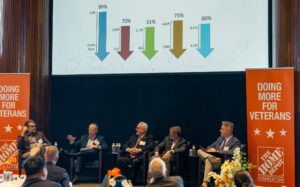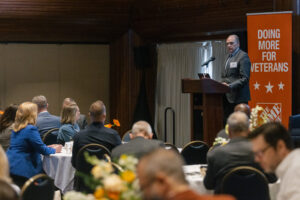

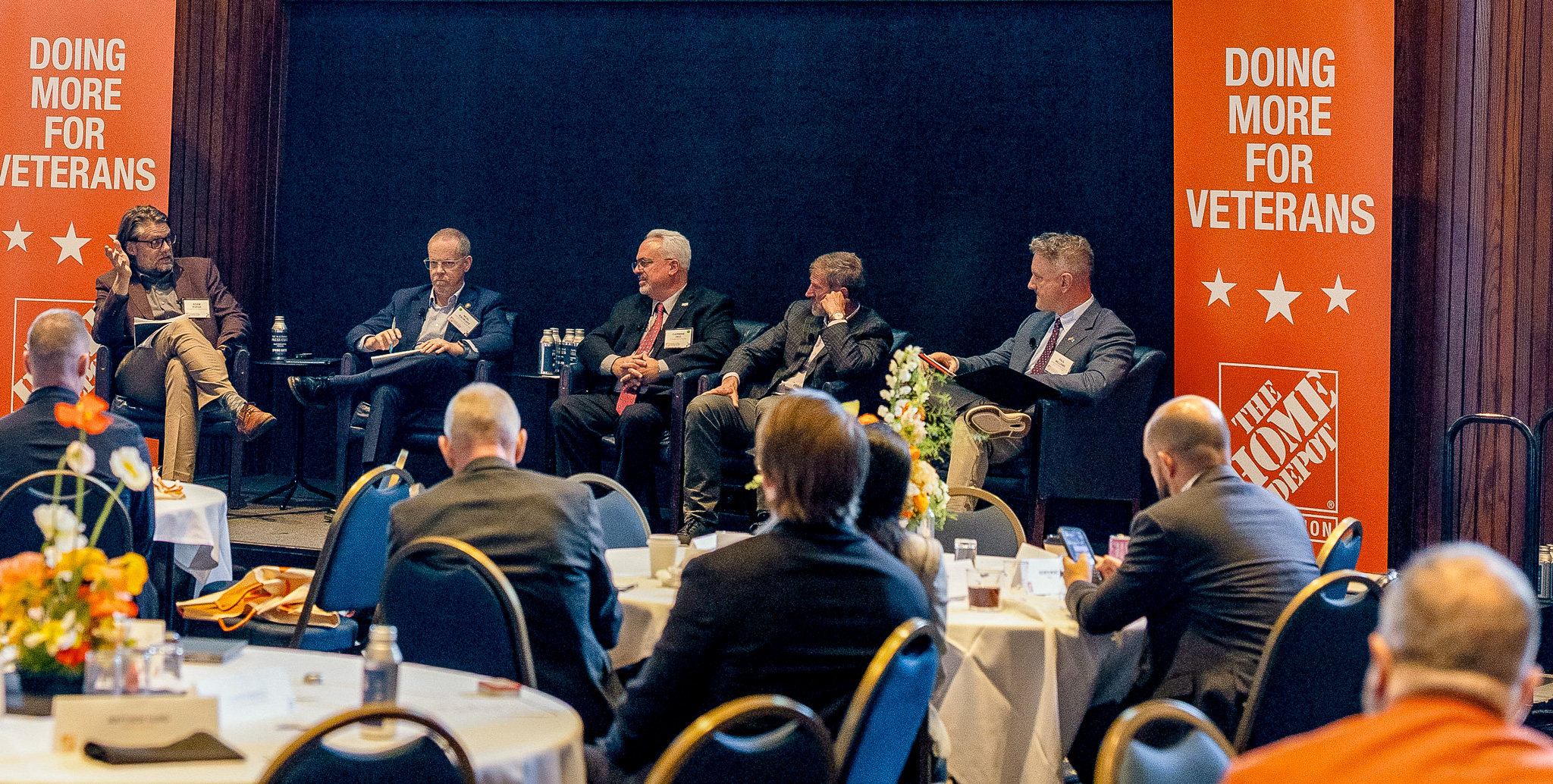
Last week, NHC and The Home Depot Foundation brought together nearly 200 housing professionals, service providers, policymakers, funders and advocates to develop solutions to end veteran homelessness. The conference, From Insight to Impact: Advancing Solutions in Veterans Housing, met at the National Press Club on October 22. Erin Izen, the Foundation’s executive director, opened the event following the Foundation’s historic announcement that it has committed $1 billion through 2032 for veterans causes.
Throughout the day, it was evident that we do know how to resolve many of the issues plaguing our housing and response symptoms, and we have seen real, measurable progress when proper resources and attention are allocated to a single problem. What was also clear is that we also have the opportunity to think bigger, more creatively, and embrace innovation alongside compassion. Simplifying systems and their integration was key to many success stories, with one panelist noting that good service delivery means that any door a veteran walks through needs to be the right door. Coordinated referral systems with robust data collection and tracking means that no person falls through the cracks of stratified or siloed organizations.
Anthony Love, Director of Community Engagement for the U.S. Department of Veterans Affairs (VA) homeless programs, set the baseline. Love has worked on this problem for nearly 30 years, including leading the Continuum of Care lead agency in Houston and twice serving in senior roles at the U.S. Interagency Council on Homelessness (USICH), and his numbers told two stories at once: one of the largest sustained reductions of any population experiencing homelessness, and more than 32,000 veterans still without a home.
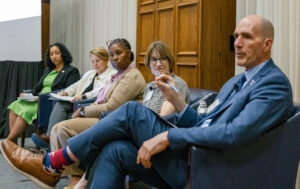
He then moderated a moving panel of veterans who have lived the reality of homelessness. Ben Jeffrey, a Navy veteran of two Persian Gulf deployments, spent more than three years chronically homeless in Phoenix before HUD-VA Supportive Housing (HUD-VASH) housed him. Today he holds the lived-experience seat on the governing board of the Maricopa Regional Continuum of Care, which directs the homeless response for a county of more than 4.7 million people. Hearing from Jeffrey, Juan Bobo, and Yolanda Caldwell was a reminder that every figure in the point-in-time count is a person who either found the right door, or did not.
In January 2010, the national point-in-time count found about 74,000 veterans experiencing homelessness on a single night. By January 2025, the most recent count available, that number had fallen to 32,495, a 56.1 percent decline and the lowest since HUD began counting veterans in 2009. Few federal social policy goals can point to results that concrete. They happened because housing providers, government, health care systems, and community organizations committed to the same goal and put real resources behind it.
But most of that progress came in the first decade, and it has since stalled. The count was already down to about 37,250 by 2020. Since 2022, the national count has hovered around 33,000, sheltered and unsheltered. More than 13,500 veterans, about two in five, were still living unsheltered on the night of the 2025 count.
Virginia, Connecticut, and Delaware were federally confirmed in 2015 and 2016 as having effectively ended veteran homelessness, and the VA counts 85 communities that have done the same. The qualifier matters. “Effectively” does not mean no veteran will ever lose a home again. It means a community knows every homeless veteran by name, moves each one into permanent housing quickly, and has the capacity to keep homelessness rare, brief, and nonrecurring.
This year, two more states announced they had reached that point. On July 29, New Jersey announced that its Bringing Veterans Home initiative had made veteran homelessness rare, brief, and nonrecurring statewide, with more veterans moving into permanent housing each month than becoming homeless. On Oct. 13, Gov. Tim Walz announced that all 10 of Minnesota’s Continuums of Care, covering all 87 counties, had effectively ended veteran homelessness, which his office described as making Minnesota the fifth state to do so.
Panels and breakout sessions featured Kathryn Monet, CEO of the National Coalition for Homeless Veterans (and NHC Board Secretary); Tramecia Garner of Swords to Plowshares; Juliana Bilowich of LeadingAge; Jennifer Molinsky of Harvard’s Joint Center for Housing Studies; and Terry Prince of the Illinois Department of Veterans Affairs. Leaders highlighting successful community-based approaches included Adam Ruege of Community Solutions; Mike Callahan of Bridges Outreach; Carmine Deo of Community Hope; Neal Loidolt of the Minnesota Assistance Council for Veterans; Paul Williams of the Minnesota Department of Veterans Affairs; and Neal Rackleff of Housing Alliance HTX. Financing discussions brought perspectives from Heather Prill of The Home Depot Foundation; Dave Foster of BDP Impact Real Estate; Lauren Montwill of UnitedHealth Group; Darryl Vincent of U.S.VETS; and Laurie Schoeman of JPMorganChase.
The communities that have succeeded did not discover a secret program. They built systems. In the breakout session, What Works: Data-Driven Solutions from Leading Programs, moderated by Adam Ruege of Community Solutions, the examples came from Minnesota, New Jersey, and Houston. Minnesota, represented by Paul Williams of the Minnesota Department of Veterans Affairs and Neal Loidolt of the Minnesota Assistance Council for Veterans, built its approach around the Homeless Veteran Registry, a statewide by-name list that lets providers work each veteran’s case together instead of asking the veteran to navigate a maze of programs.
New Jersey, represented by Mike Callahan of Bridges Outreach and Carmine Deo of Community Hope, launched Bringing Veterans Home in November 2024. It has organized six regional hubs and permanently housed more than 2,500 veterans, backed by more than $30 million in state and federal funds over two years. Neal Rackleff, now with Housing Alliance HTX, Houston’s housing authority, was the city’s housing and community development director when Houston effectively ended veteran homelessness in 2015.
Speakers were just as emphatic about prevention. Some programs still require a person to spend at least one night homeless before they can help, which amounts to waiting for a crisis to become a catastrophe. Prevention will matter more each year as the veteran population ages and more households call for help after a financial shock, whether the death of a spouse or simply rents that have outrun fixed incomes in a country that still builds too few homes.
Swords to Plowshares in San Francisco has been doing this work for more than half a century. In August 2025, Garner and Michael Blecker, the Vietnam veteran who led Swords to Plowshares for 42 years, showed me Edwin M. Lee Apartments in San Francisco’s Mission Bay. Developed with Chinatown Community Development Center, the building houses 62 formerly homeless veterans with disabilities alongside low-income families. Services include mental health care, peer support, VA case management, and a free meal six days a week, as well as a garden courtyard the veterans share with their neighbors. It cost $78 million, about $655,000 per unit, assembled from federal, state, city, and private sources, including HUD-VASH rental subsidies and California’s Veterans Housing and Homelessness Prevention Program. That is a lot of money. It is also less per unit than many market-rate projects in San Francisco.
The plenary session, Financing Innovation – New Approaches to Ending Veteran Homelessness, focused on how to pay for that model. Affordable housing developers already assemble complicated capital stacks to make projects work. Adding supportive services, health care coordination, and the specific needs of veterans makes that harder, and services are usually the first thing squeezed. Services once funded directly through McKinney-Vento homeless assistance funding increasingly come out of property operating budgets, so every dollar spent on case management is a dollar not spent keeping the building safe and habitable. We need more homes, but we also need funding models that pay for the full cost of keeping people housed. Having a health insurer and a bank on the same stage as a veterans’ service provider is an indication of the possibilities for where some of that money can come.
As housers, we often find ourselves searching for the next innovative program or policy solution. Innovation matters, but so does making better use of the tools and partnerships we already have and bringing more of the affordable housing industry into this work. The conference reinforced that we have a strong foundation to build upon, and there are opportunities to bring more of the affordable housing industry into this work.
The next chapter in ending veteran homelessness will not be defined by one program, one funding source, or one organization. It will depend on how effectively we connect the resources, expertise, and partnerships that already exist, while creating the housing opportunities that are still missing. We have demonstrated that progress is possible. Now we must ensure that progress is sustainable.
Many panelists spoke to the fact that a single person, a champion or czar, spearheaded the effort to end veteran’s homelessness in their community. That single person was determined to maintain focus, expand funding opportunities, and have hard conversations with the service providers already doing incredible work to help those experiencing homelessness about what could change to be able to do more. As our veterans know from hard fought experience, leadership matters. So does unit cohesion. Working together, we can live in a nation where our veterans can have a safe, stable, and sustainable home of their own.