
Housing affordability is often discussed through the lens of supply, financing, zoning, and development costs. These are critical factors. But one of the most important conversations I participated in during this year’s Wells Fargo Water Week reinforced a reality that is becoming increasingly difficult to ignore: water is also a housing issue.
Wells Fargo Water Week explores how collaboration, innovation, and finance can advance solutions that strengthen communities through water stewardship, resilience, and innovation. This year’s events in Washington, D.C., Tempe, Arizona, and New York City brought together leaders from across sectors to explore regional priorities and opportunities, each highlighting a different aspect of the water challenge.
In Washington, D.C., our Housing + Water convening gathered a wide cross-section of leaders from housing, water, utilities, insurance, sustainability, finance, government, and the nonprofit sector to explore the connections between housing affordability, water affordability, and community resilience. One theme surfaced repeatedly: these challenges are deeply connected, and they are best addressed together.
Across the country, affordable housing providers are facing rising operating costs. From leaking pipes and running toilets inside buildings to aging systems and extreme weather outside them, water increasingly influences the cost of developing, preserving, operating, and insuring affordable housing. And for families, affordability does not end with the rent or mortgage payment. When water systems become strained or inefficient, those costs often find their way back to residents. In fact, recent studies show that household water bills are rising faster than inflation.
That connection was especially clear in the closing session, Risk, Insurance, and the Future of Housing Preservation, featuring the National Housing Conference, Housing Partnership Network, come dream. come build., and the Brookings Center for Community Uplift. Property insurance has quickly become one of the most pressing threats to housing affordability, and mission-driven developers operating on thin margins are feeling it first. One of the most striking takeaways: floods and storms get the headlines, but everyday indoor water damage, such as running toilets, leaking pipes, and failed water heaters, is far more likely to drive insurance claims. Because insurers price for risk, many of the most effective solutions to rising premiums are practical, preventable, and within reach.
That is why Wells Fargo is proud to fund and participate in the National Housing Conference’s Residential Property Insurance Collaborative (RPIC). RPIC brings together housing advocates, researchers, lenders, and insurers to find a “third way” to manage rising insurance costs. It is identifying how investments like leak detection, better water management, and stronger construction can translate into fewer claims and more affordable coverage, and how those costs should be shared.
Our grant support for RPIC is part of a broader $1 million philanthropic investment supporting organizations that help affordable housing communities reduce operating costs, improve water management, address emerging insurance challenges, and preserve long-term affordability.
The broader investment supports organizations and initiatives addressing these challenges:
- Mercy Housing will address rising operator costs associated with water by leveraging ProdigyLink’s prevention-first technology across a number of its properties.
- Stewards of Affordable Housing for the Future is advancing Fixing the OpEx Leak: Water Management in Affordable Housing, helping providers catch leaks early, lower utility bills, and prevent the water damage that drives insurance claims.
- Project BRAVO in El Paso, Texas, is expanding families’ access to safe, potable drinking water through innovative solutions, a
- reminder that for some households, the most basic water need is still unmet.
- In Arizona, the Community Irrigation Revitalization Initiative is revitalizing aging irrigation infrastructure, improving water efficiency, expanding tree canopy, and reducing heat, showing that resilience investments can deliver multiple returns.
What we’re learning is that affordability is shaped by systems as much as by housing availability itself. When water infrastructure is unreliable, utility costs rise, or water damage drives up insurance costs, housing providers and residents alike feel the effects. If we want affordable housing to remain affordable, we must pay attention to the systems that support it.
Through continued innovation, investment, and partnership, including with NHC and the members of RPIC, we can help create communities that are not only more affordable today, but more resilient for generations to come.
Event Photos included below
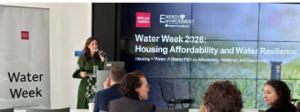
Sarah Bainton Kahn, Head of Housing Access & Affordability Philanthropy, Wells Fargo Foundation opening remarks at Wells Fargo Water Week housing event in Washington, DC.
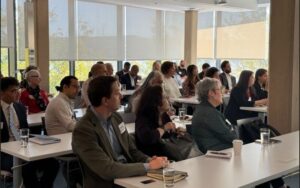
Participants in the Wells Fargo Water Week housing event in Washington, D.C.
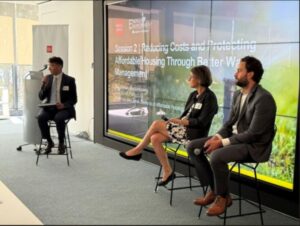
Reducing Costs and Protecting Affordable Housing Through Better Water Management Panel. From left: Alex Jarrah, Energy & Sustainability Manager, Stewards of Affordable Housing for the Future (SAHF), moderator; Laura Sardilli, Founder and CEO, ProdigyLink; and Max Stewart, Senior Environmental Analyst, Mercy Housing.
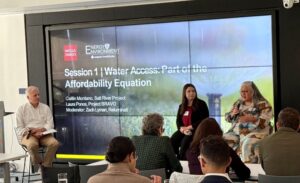
Water Access: Part of the Affordability Equation Panel. From left: Zach Lyman, Managing Director, Reluminati, moderator; Laura Ponce, Executive Director, Project BRAVO; and Caitlin Montano, Water Planning Analyst, Salt River Project.