

Last year, NHC reported that the housing affordability crisis had reached the middle class. Workers in occupations that were once seen as reliable paths to financial and housing security are increasingly being priced out of homeownership and rental opportunities. The alarming trend is continuing, according to NHC’s Paycheck to Paycheck database and its latest report examining housing affordability across the United States. The newly released research examines data from 2020–2025 and finds that although housing affordability is finally a part of the national dialogue, we have a lot of work to do to undo the damage of the last five years. The latest data tell a clear story: Housing affordability has continued to deteriorate, but measurable improvement is not impossible.
If you aren’t familiar with Paycheck to Paycheck, it is worth exploring on our website. The tool analyzes housing affordability across 390 metropolitan statistical areas (MSAs) by comparing wage data for nearly 300 occupations from the Bureau of Labor Statistics (BLS) to fair market rents (FMRs) calculated by the U.S. Department of Housing and Urban Development (HUD) and typical home values provided by the Zillow Home Value Index (ZHVI). Looking beyond the alphabet soup of the data sources, Paycheck to Paycheck is an approachable resource for consumers, researchers, and policymakers alike to understand which occupations can afford housing costs within their respective communities without being cost burdened.
Our methodology aligns with our aims for housing affordability. Rental costs should represent no more than 30% of a household’s annual income. For homeownership, we assume a 10% down payment and limit housing costs to no more than 28% of a household’s income to account for maintenance expenses. NHC has long sought to combat the myth that a down payment on a home must be 20%— a notion that stubbornly persists despite many mortgage products that offer 10%, 3%, and even 0% down. This shift in thinking matters even more today, when home prices are so elevated that a 20% down payment can total tens of thousands of dollars and, in some markets, even reach $100,000 for a typically priced home.
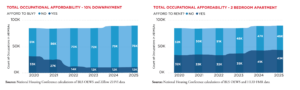
The analysis finds that in 188 metropolitan areas, the income needed to purchase a typically priced home with a 10% down payment in 2025 is at least twice what was needed in 2020. That translates to a more than 25 percentage point drop in the number of occupation-MSA combinations that could afford to purchase a home, such as a Nurse Practitioner in Idaho Falls, Idaho; or a Heavy and Tractor-Trailer Truck Driver in Warner Robins, Ga.
Among occupation-MSA combinations that could afford to purchase a home in 2020 but could no longer do so in 2025, the average annual salary in 2025 was $70,283. Just a few years ago, that wage would have been enough to afford a typically priced home in hundreds of MSAs, and certainly within affordability for 2-bedroom rent. Today, depending on where they live, it may not even be close to enough.
Rental affordability declined less sharply than homeownership affordability, but tells an equally alarming story for a housing option that is intended to be more affordable. Though the percent of occupation-MSA combinations that can afford rent for a 2-bedroom apartment held relatively steady since last year, it declined one point to 52% in 2025. That means nearly half of the tracked occupations cannot afford a 2-bedroom apartment without facing housing cost burdens. Since 2020, 2-bedroom rental affordability across the dataset dropped by over 10 percentage points. This is consistent with other research ringing the alarm for rental cost burdens. Though the declines in affordability for rental units do not see the same dramatic drops in affordability as homeownership, which is highly sensitive to interest rates and other economic factors, rental affordability has shown steady and persistent decline over the last five years. In 2025, 38 MSAs require a salary of $75,000 or more to afford a 2-bedroom apartment. If the current trajectory continues, we will soon find ourselves in a country where more renters are struggling with their monthly housing costs than not.
Importantly, many of the workers who lost affordability were earning more, not less. Median pay for loan officers in Mansfield, Ohio, increased nearly 27% between 2020 and 2025, from $47,840 to $60,750. Human resources specialists saw their salaries increase nearly 26%, from $48,080 to $60,430. Industrial machinery mechanics went from $49,940 to $62,150, a 24% increase. All could afford to purchase a typically priced Mansfield home in 2020. None could in 2025.
This report also reinforces why increasing housing supply remains so important. There is no single policy responsible for the affordability challenges documented in Paycheck to Paycheck, and there will be no single policy that solves them. Interest rates, home prices, rents, wages, insurance costs, taxes, and local market conditions all affect what households can afford. But we cannot meaningfully address a nationwide shortage of affordable housing without building more homes.
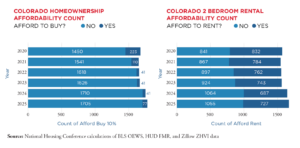
In Colorado, supply-side solutions may be helping to turn the tides of affordability. It is one of the few states examined in this report that shows year-over-year improvement for homeownership and rental affordability despite an overall decline over the past 5 years. This has happened in conjunction with the state’s concerted effort to increase its housing supply. Housing nevertheless remains extremely unaffordable for Colorado workers, with only 4% of occupation-MSA combinations capable of affording homeownership in 2025, and only 41% met the threshold for renting a 2-bedroom apartment. But those numbers do represent improvements since 2024, and further research will reveal whether the reversed course is a one-time impact or signs of sustained progress.
Last year, our message was that policymakers needed to hear what middle-class Americans were telling them: housing had become unaffordable even for workers with jobs and incomes that historically provided a path to housing stability.
This year, the message is more complicated. There are some early signs of progress, but the hole we have dug since 2020 is deep. A worker earning a middle-income salary who has received raises, advanced in their career, and done everything we traditionally associate with achieving economic stability can still be further from homeownership today than they were five years ago. And, if those in the middle of the income spectrum are unable to afford housing, it only further limits the affordable housing that is available to households lower on the income spectrum who will bear the brunt of this crisis. When we talk about affordable housing, we are used to talking about households earning 30-80% range of area median income, and often less. As affordability struggles reach further into the income spectrum, we only complicate the array of solutions needed to address the issue throughout the country. One thing is for certain – wage growth is being consistently outpaced by housing costs across communities. Though the task may seem overwhelming, we can and must continue to build our way out.