
Representative Emanuel Cleaver (D-Mo.) called the bill “probably the most sweeping changes in HUD regulations in a quarter of a century, perhaps ever; and what we have done is we have remodeled, or refashioned, or recast, or redesigned many of the programs impacting HUD.” It passed both the House and Senate overwhelmingly and became law after the President signed it. But he wasn’t referring to the 21st Century ROAD to Housing Act (ROAD). He was talking about the Housing Opportunity Through Modernization Act (HOTMA), which was signed into law in 2016. It took seven years to write the final regulation, and eleven years later, it has yet to be fully implemented.
If efforts to implement ROAD take half as long, our failure will have ramifications for a generation. We must do better. Author Rita Mae Brown wrote, “Insanity is doing the same thing over and over and expecting a different result.” The quote is so well liked, it has been widely attributed to Albert Einstein. He never said it, but he could have. We have to think about our universe differently or we will misunderstand it completely.
The 21st Century ROAD to Housing Act contains more than 50 individual provisions that require new regulations, administrative procedures, and federal guidance before a single additional home gets built or a single family benefits.
The federal agencies tasked with this work, especially the U.S. Department of Housing and Urban Development, face an enormous lift. They must translate legislative language into workable regulations across dozens of programs, from manufactured housing to HOME to community development. And they must do this despite last year’s workforce reductions. To expect them to do it alone, without the operational expertise of the practitioners who use these programs every day, would be both unfair and unwise. To believe that more government bureaucrats will make implementation more efficient is to believe in a universe that is proven not to exist.
Housing advocacy has been dominated by a single word: more. More funding, more programs, more resources. I will always argue for more investment in affordable housing. But our biggest constraint isn’t just a scarcity of funds. It’s a scarcity of competent execution. We have created systems so burdened by competing priorities, procedural hurdles, and layers of review that they undermine the very outcomes they seek to achieve.
Consider the HOME Investment Partnerships Program. HOME’s locally-directed funding supports both homeownership and rental development and offers tenant-based rental assistance—allowing local agencies to target resources, not just fill federal quotas. Since the program’s inception in 1992, HOME funds have been used to build or preserve more than 1.35 million affordable homes, provide direct rental assistance to 430,000 households, and help countless working families buy their first home.
State by state, HOME is the difference-maker for local markets. In Arkansas, more than 15,000 homes have been built or preserved, nearly $2.1 billion in investments leveraged, and 20,000 jobs supported. In South Carolina, 22,000 homes have been built or preserved, $2.8 billion in investments leveraged, over 26,000 jobs supported, and $1.7 billion in local income. For communities trying to stabilize rising rents, keep seniors in their homes, or provide safe, attainable paths to homeownership, HOME is the irreplaceable gap-filler.
But as effective as HOME is, it is not efficient. It can be bureaucratic, complicated, overly restrictive, and expensive to use. Its administration suffers from years of sedimentary regulation that has impacted its efficiency and effectiveness. The contrast between what’s possible and what our current systems produce is stark. In San Francisco, California, one development cost over $1.1 million per unit. Just one application for a single funding source was 359 pages long. That’s insane.
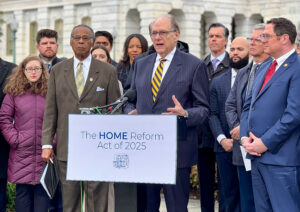
Poorly written regulations often create the very delays and costs they should prevent. The bipartisan HOME Reform Act, written by Rep. Cleaver and House Financial Services Committee Housing and Insurance Subcommittee Chairman Mike Flood (R-Neb.) and incorporated into the ROAD package, makes meaningful reforms that promote flexibility, streamline requirements, and reduce barriers to entry. It exempts small projects of 15 units or less from duplicative environmental reviews. It increases allowable income limits and home prices to reflect market realities. These are exactly the kinds of reforms that can help existing investments deliver greater impact.
ROAD reflects what’s possible when Congress works together. But it could easily suffer the fate of HOTMA if we don’t take an entirely new approach to writing and implementing the regulations that govern the program.
It’s not enough to simply implement the 50-plus provisions of the bill. We must do so in a way that untangles the knots of complexity, aligns overlapping requirements, and prioritizes outcomes over process. We must hold ourselves accountable for outcomes, not just participation. This is our chance to prove that government can be a powerful force for good when it is empowered to be efficient, and when it partners with those who know how to get things done.
At NHC, we often say we’re “the place where housers come to get things done.” That’s not just a tagline—it’s a fact built on nearly a century of action and impact. It is in that spirit that we launched a major initiative to support the implementation of the ROAD to Housing Act. Our goal is simple: to help HUD and other agencies get this right, and to do it faster than they could on their own.
This effort is designed around three core principles:
- Leverage experience: The best ideas for effective regulation come from those who use the programs every day. Our process will identify and channel the operational expertise of organizations across the country to ensure that new rules are workable, efficient, and reflect the realities on the ground.
- Support proven leadership: Many of our members are already leaders on specific titles within the bill. The HOME Coalition, for example, has an unparalleled depth of expertise on the intricacies of that vital program. Our role is not to supplant these efforts, but to support them, connect them, and ensure their work informs the broader implementation landscape.
- Resolve differences diplomatically: In a coalition as broad as ours, disagreements are inevitable. Our commitment is to provide a forum where those differences can be aired constructively and resolved diplomatically. We must remain true to our institutional values while finding the common ground necessary for progress. Unity got the bill this far; it is the only thing that will make its implementation a success.
To power this work, NHC has made a major investment in agentic AI. Our Housing Supply Working Group, co-chaired by Stockton Williams of the National Council of State Housing Agencies and Marisa Calderon of Prosperity Now, will be working with our AI team to begin drafting regulatory language for HUD.
By providing HUD with high-quality, stakeholder-vetted draft language at the beginning of their process, we can save the agency months of work. It allows the deep expertise of the housing community to be baked into the regulatory DNA from day one, rather than simply offered as feedback during a formal comment period at the end. It transforms the dynamic from critique to collaboration.
The passage of the 21st Century ROAD to Housing Act was a victory for all of us, and for the country. It was a triumph of pragmatism and bipartisanship. But it is only the beginning. The marathon of implementation stretches before us, and its course is filled with challenges. Yet, I am more optimistic than ever. I have seen what this community can do when we work together. We have the expertise, the passion, and now, a framework for collaboration to meet this moment.