

In this issue
June 7, 2026
Issue 95-23
- Landmark housing bill quietly becomes law
- Senators, housing groups push back on OMB grant proposal
- CFPB seeking comments on mortgage requirements
- HUD, VA announce additional veteran voucher funding
- States, homelessness groups again sue HUD over CoC funding
- Housing groups call for NHIA
- Senators press OMB on stalled housing funds
- Chart of the week: High-priced homes drive uneven spring appreciation
Regulatory Reform
Landmark housing bill quietly becomes law
The bipartisan, bicameral 21st Century ROAD to Housing Act officially became law at midnight Friday after President Trump neither signed nor vetoed the legislation within the 10-day constitutional review period. The bill saw brief setback after its formal signing ceremony was abruptly cancelled in June, but remains widely supported by members of Congress and housing advocates. With the review period now expired, ROAD will move forward, delivering a broad package of housing reforms intended to expand housing supply, improve affordability, modernize federal housing programs, and strengthen the nation’s housing finance system. Housing organizations celebrated the legislation becoming law, and lauded it as a significant step toward advancing long-term solutions to the nation’s housing affordability challenges.
“Today marks a major victory for American families, communities, and the housing community that worked for years to make the 21st Century ROAD to Housing Act a reality. With this bipartisan legislation now law, long-needed reforms can move forward to strengthen our nation’s housing system. This legislation will only be as effective as its implementation. Regulations will need to be written that will ensure that the bill’s promise becomes a reality,” stated NHC President and CEO David Dworkin. “The housing affordability crisis is far from over, and our work is not done. But today is an important milestone. NHC looks forward to working with the Trump Administration, Congress, and our partners across the housing ecosystem to ensure this law is implemented effectively and to continue advancing solutions that make housing more affordable and accessible for all.”

Senators, housing groups push back on OMB grant proposal
A proposed rule from the Office of Management and Budget (OMB) that would change government-wide requirements for federal financial assistance is drawing pushback from lawmakers and various stakeholders over its potential impact on grant administration, federal program stability, and affordable housing development. The proposed rule makes sweeping revisions of policies and requirements for discretionary grants and other forms of federal assistance, with OMB claiming that the changes are intended to improve transparency, accountability, and oversight. However, many organizations both in housing and other industries are expressing deep concern that the changes would unlawfully restrict grants to groups that align with the Administration’s political ideology.
Sens. Patty Murray (D-Wash.), Gary Peters (D-Mich.), Jeff Merkley (D-Ore.), and Senate Democratic Leader Chuck Schumer (D-N.Y.) led all Senate Democrats in a letter demanding that OMB Director Russell Vought rescind the proposal. The senators argued the rule would exceed OMB’s authority, undermine Congress’ role in directing federal spending, and allow federal agencies to terminate or suspend grants with limited notice. The letter also raised concerns that political appointees would be given greater authority over grant decisions, including after expert review processes.
Separately, Senate Appropriations Committee Chair Susan Collins (R-Maine) asked OMB to extend the comment period by at least 90 days and withdraw portions of the rule that she said could harm small and rural communities, scientific research, and biomedical research. Collins wrote that while transparency and accountability should guide federal funding oversight, the proposed rule would impose new burdens on award recipients and create uncertainty for multi-year awards.
Housing groups are recommending that housing agencies submit comments opposing the rule, warning that the proposal could disrupt federal funding streams and create uncertainty for affordable housing providers. Some raised concerns that the rule could allow agencies to stop funding housing programs for vague reasons, add terms and conditions after grants are already underway, and impair affordable housing development by making federal funding less predictable. Local government advocates also expressed concerns over increased administrative burdens and overriding local authority.
Comments are due July 13, and the proposal has already generated nearly 100,000 responses.
CFPB seeking comments on mortgage requirements
The Consumer Financial Protection Bureau (CFPB) is seeking public input on whether to revise mortgage disclosure requirements and other lending rules as part of a broader review of regulations that may raise origination costs or limit access to mortgage credit. The request for information focuses on the Truth in Lending Act (TILA) and Real Estate Settlement Procedures Act (RESPA), often called TRID, as well as the right of rescission and reverse mortgage disclosures. The effort follows an executive order from President Trump that directs federal agencies to review mortgage rules that may increase compliance costs or reduce credit availability.
The CFPB is asking whether current disclosure timing requirements, tolerance thresholds, electronic disclosure rules, and other compliance obligations create unnecessary burdens while continuing to provide adequate consumer protections. For reverse mortgages, the Bureau is considering whether borrowers would benefit from a single integrated disclosure tailored to the product.
HUD, VA announce additional veteran voucher funding
HUD and the Department of Veterans Affairs (VA) announced $33 million in funding for the HUD-Veterans Affairs Supportive Housing (HUD-VASH) program to support 2,532 new vouchers for veterans experiencing homelessness. The awards will go to 265 public housing authorities (PHAs) across 44 states. HUD is also awarding $10 million in administrative fees to 289 PHAs in 46 states to help lease HUD-VASH vouchers and improve program delivery.
HUD-VASH combines HUD Housing Choice Voucher rental assistance with VA case management and clinical services delivered through VA entities. HUD said the new awards bring the total number of active HUD-VASH vouchers to more than 118,000 nationwide, and noted that veteran homelessness has declined by over 56% nationwide since 2010.
“No one who served their country should face homelessness,” said VA Secretary Doug Collins. “This funding will help us deliver critical support to thousands of Veterans across the nation, and builds on the progress made last year when VA housed more than 51,000 homeless Veterans.


Homeownership and Homelessness
States, homelessness groups again sue HUD over CoC funding
A 24-state coalition and a separate group of homelessness organizations and local governments filed new lawsuits challenging the U.S. Department of Housing and Urban Development’s (HUD) latest changes to Continuum of Care (CoC) funding, arguing the agency is again attempting to shift resources away from permanent housing. The state lawsuit, led by attorneys general from Washington, New York, and Rhode Island, challenges HUD’s June 1 Notice of Funding Opportunity (NOFO) for FY2026 funds. The NOFO creates a $1.3 billion set-aside for new projects, including transitional housing and supportive services, that plaintiffs argue creates a de facto cap on permanent supportive housing. Maryland Attorney General Anthony Brown said the change could threaten housing for at least 97,000 residents of CoC-funded permanent housing nationwide.
The lawsuit follows a June 30 ruling in a separate challenge to HUD’s FY 2025 CoC funding. In that case, the U.S. District Court for the District of Rhode Island ruled that HUD’s FY 2025 NOFO violated the Administrative Procedure Act and could not be implemented. That NOFO would have imposed a 30% cap on permanent housing funding. The National Alliance to End Homelessness and other plaintiffs in a parallel case said the FY 2025 criteria could have pushed an estimated 170,000 people into homelessness.
Homelessness organizations, local governments, and service providers also filed a supplemental complaint challenging the FY 2026 NOFO, arguing that the new funding structure bears similarities to provisions already found unlawful. Democracy Forward, which represents part of the coalition, said the new NOFO sets aside nearly one-third of available funds for new projects only, despite congressional direction that funding be available to renew existing projects. The plaintiffs also object to new grant conditions tied to executive orders on diversity, equity, and inclusion; gender identity; and local cooperation with federal immigration enforcement.
HUD Secretary Scott Turner has criticized permanent housing programs, stating that “housing alone will not solve a crisis driven by addiction and mental illness.”
Housing groups call for NHIA
A coalition of more than 40 national housing, financial services, community development, and consumer organizations including NHC is urging House leaders to include a version of the Neighborhood Homes Investment Act (NHIA) in any new tax package. In a letter to Speaker Mike Johnson (R-La.) and House Ways and Means Committee Chairman Jason Smith (R-Mo.), the groups state that while recent legislation addressed affordable rental housing and regulatory barriers, additional action is needed to expand the supply of affordable starter homes and homeownership opportunities.
The letter explains that NHIA is a market-based approach that would use federal tax credits to close the gap between the cost of constructing or rehabilitating homes and their market value in distressed neighborhoods, rural communities, and areas recovering from natural disasters or economic decline. Sponsors Rep. Mike Kelly (R-Pa.) and Sen. Todd Young (R-Ind.) provided a narrower four-year version intended to reduce the proposal’s cost while preserving its core structure.
Senators press OMB on stalled housing funds
U.S. Sens. Mark Warner (D-Va.) and Tim Kaine (D-Va.) joined Sen. Jack Reed (D-R.I.) and 20 other senators in urging the OMB to release approximately $750 million in affordable housing construction funds that have been held for over a year. The funds are available through the Capital Magnet Fund (CMF), Housing Trust Fund (HTF), and Housing Production-Financial Assistance Awards (HP-FA) programs, which support the development, preservation, rehabilitation, and expansion of affordable housing. In their letter, the senators argued the funds could help build or rehabilitate more than 63,000 homes at no cost to taxpayers.
The letter comes as lawmakers continue to focus on housing supply and affordability following passage of the bipartisan 21st Century ROAD to Housing Act. The senators said OMB has historically ensured annual CMF and HTF funds were released, including during President Trump’s first term, and argued that withholding the funds undermines efforts to expand supply at a time when housing costs remain elevated.
“Today, Americans are suffering through a housing affordability crisis. Single-family home prices and the average age of first-time homebuyers hit record highs last year, while more households are paying unsustainable amounts of rent than ever before,” the senators wrote. “You have the ability to increase our nation’s housing supply and help address this crisis. With that in mind, we urge you to direct the release of these funds without any further delay.”
NHC Updates

New episode released!
“Communicating Before, During, and After a Natural Disaster“
On April 8, the National Housing Conference hosted its Solutions for Housing Communications convening at the National Press Club. The event brought together policymakers and affordable housing stakeholders to discuss tangible, impactful, and achievable actions to address the nation’s most critical housing policy challenges.
In this week’s episode, we revisit the panel, “Communicating Before, During, and After a Natural Disaster,” featuring a discussion on how to communicate clearly and credibly before, during, and after a disaster. Panelists share practical messaging strategies, discuss common communication pitfalls, and offer guidance on reaching residents, policymakers, and the media at each stage of a disaster. Listen here.

Chart of the week: High-priced homes drive uneven spring appreciation
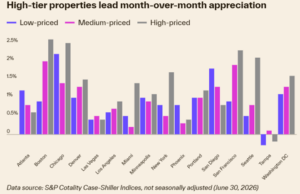
Home price growth strengthened this spring, but gains were concentrated among higher-priced properties and varied significantly across markets according to latest data from Cotality. In April, monthly appreciation averaged 1.15% for high-priced homes, compared with 0.90% for medium-priced homes and 0.74% for lower-priced homes. High-tier properties led growth in several major markets, including Boston, Chicago, New York, San Francisco, Seattle, and Washington, D.C., while lower-priced homes posted the strongest gains in only a handful of cities. National home prices increased 0.8% in April, below the 1% average April increase recorded from 2015 through 2019. More recent data show this divide continuing into May, as equity-rich buyers remained better positioned to absorb elevated mortgage rates, property taxes, insurance premiums, and other ownership costs, while affordability pressures continued to limit first-time and move-up buyers.
What we’re reading
The Washington Post analyzed a study published by the Federal Reserve Bank of Dallas and how President Trump is using it to inflate the impact of immigration on housing affordability. Administration officials are often citing the study directly claiming that 30% of rising home prices are due to a surge of illegal immigration during the Biden administration. As explained by the Post, the research itself estimates that unauthorized immigration contributed about 6.6 percentage points between early 2021 and early 2024, meaning it accounted for roughly 30% of the observed price growth, not that it increased home prices by 30%.
The Daily podcast by the New York Times reported on the latest saga of the 21st Century ROAD to Housing Act, including the cancelled signing ceremony and President’s refusal to sign the bill. The cancellation of the signing ceremony came with a call on Congress to pass the Save America Act, which would impose new voting restrictions. The progress of the housing bill and wide ranging support were discussed during the episode.
The Federal Reserve Bank of Cleveland published a report that explores how CDFI’s are a highly effective tool for expanding capital into places and populations that mainstream finance often overlooks, including low- and moderate-income communities, rural areas, and disinvested neighborhoods. It explains that CDFIs support local economic development by financing affordable housing, small businesses, community facilities, and early-stage projects, often providing patient, flexible capital that helps other investments follow. The report also emphasizes that the CDFI Fund is essential because it supplies equity capital, technical support, and program funding that help CDFIs grow their capacity and deliver broader housing and economic benefits nationwide.