

For years, housing affordability has long been a policy concern for large urban areas and coastal cities, particularly for households making minimum wage. Today that notion no longer holds. It is now painfully clear that housing affordability is not a problem only for those of low wealth or low income – it is a problem for all of us.
NHC’s newly released report, “Priced Out: When a good job isn’t enough,” reveals that middle-class Americans are facing a housing affordability crisis once assumed to be a concern only for low-income households. By tracking mortgage and rental affordability each June from 2019 through 2024, the report provides snapshots of how the landscape has shifted since before the pandemic.
The findings are alarming. Nearly one third (32%) of 390 tracked metropolitan areas now require double the salary needed to afford a home in 2019, and almost half (45%) of the metropolitan statistical areas (MSAs) require six-figure incomes to purchase a typically priced home.
Moreover, the changes are not only coastal. 150 of the tracked MSAs requiring six-figure salaries to buy a home are outside of California, and 64 are outside of coastal communities that have historically contended with high costs. But the impact of those rising costs is being felt across the income spectrum, with middle-income and in some cases upper middle-income households feeling the pressures of housing unaffordability within their communities.
Professions in fields that demand extensive education, training, or experience are finding themselves impacted by this shifting paradigm. As a result, rising housing costs and lagging wage growth have expanded the conception of who is considered cost-burdened. Concerns over housing unaffordability now extend to employers who struggle to keep wages in step with rising housing costs, impacting their ability to attract and retain workers and changing how communities think about their economies.
The report examines a notional workplace in five MSAs including a construction site in Asheville, N.C.; a Middle School in Boise, Idaho; an Auto Shop in Houston, Texas; a Law Firm in Tampa, Fla.; and a Dental Office in Seattle, Wash. In each workplace, median-earning workers are watching affordability slip away.
In Asheville, civil engineers cannot afford to buy a home despite a salary of nearly $100,000. Construction laborers and electricians cannot even afford to rent one-bedroom apartments. In Boise, librarians lost the ability to rent a two-bedroom in 2022 and never recovered. A first-line supervisor of mechanics, installers, and repairers in Houston could afford to purchase a home in 2021, but fell more than $25,000 short of affording a home in 2024. Paralegals in Tampa lost affordability of two-bedroom apartments in 2023, and then lost affordability of one-bedrooms in 2024. In Seattle, a dentist earning over $200,000 a year cannot afford a typically priced home with 10% down.
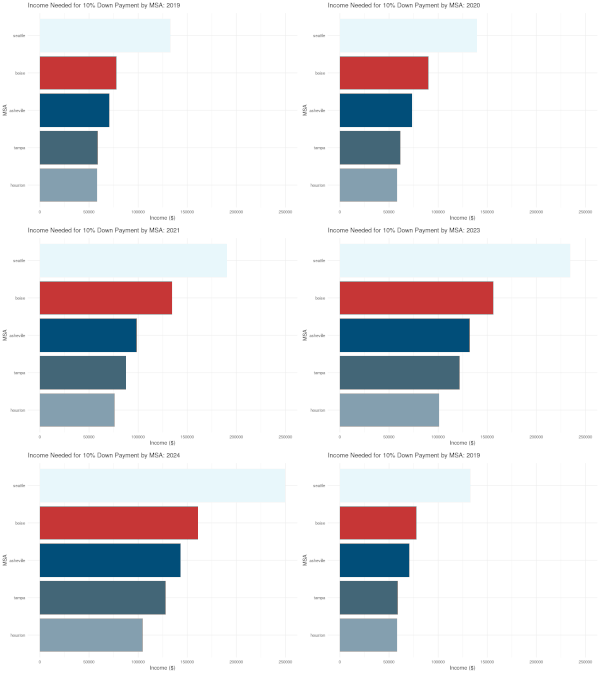
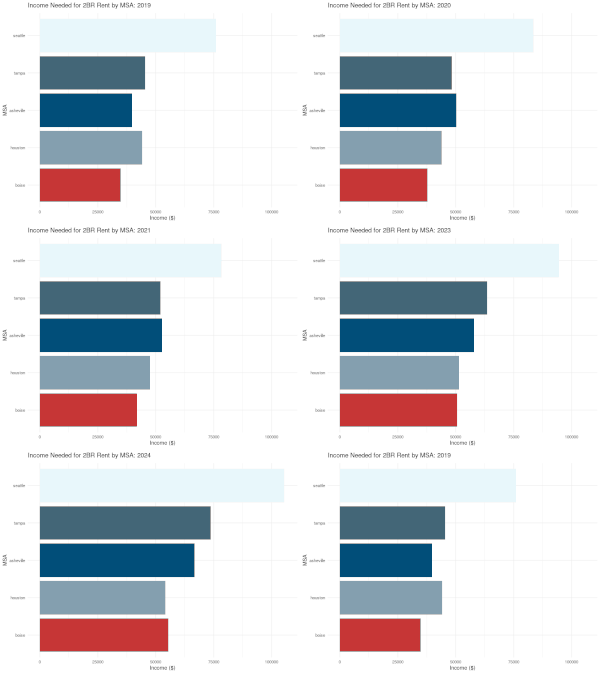
With so many professions falling short of the income needed to afford housing payments without becoming cost-burdened, the availability of affordable housing for low- and extremely low-income earners – who face the brunt of this crisis – is even more strained.
The five MSAs examined represent vastly different markets. Yet, unaffordability is a powerful and debilitating factor throughout the United States. Housing groups have long warned that without increasing supply, housing will only become more expensive. In order to afford fairly priced rentals and typically priced homes, working households simply do not earn enough income to keep up. Without intervention, homelessness will only continue to increase across the country for the simple reason that apartments are too expensive for working households to afford.
The paradigm of affordable housing is no longer only of lower income families, it is a concern for all communities, all employers, and all employees. The promise heard by young people for decades assured them that getting an education and securing a career in a well-paying field would allow for a comfortable life in areas of high opportunity, and achieve the freedom and stability of homeownership that often defines the American Dream. But the housing affordability crisis has derailed that promise, and without intervention will only compound the policy challenges facing households across the country at every income level.