
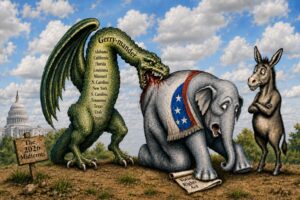
Image created by the author using CHAT GPT DALL-E, © 2026 by National Housing Conference
Democratic Party leaders and civil rights advocates across the country are reeling over the aggressive efforts by Republican legislatures to redraw their congressional maps in the midst of a heated midterm election cycle. To date, Republicans have been successful in eliminating mostly African American safe seats and spreading those votes around neighboring districts to ensure a Democrat cannot get elected.
Republicans hope this last-minute move will help them retain control of the House by creating a firewall to protect against the president’s record low popularity. They should know better. They were the ones who helped create so many congressional districts gerrymandered to elect more Black Members of Congress in the first place.
Most of the congressional districts being redrawn are currently held by members of the Congressional Black Caucus (CBC). Civil rights leaders throughout the country are understandably outraged. “It is a direct attack on our democracy and our Constitution to dismantle majority-Black districts. A democracy without Black representation is not a democracy,” said Kristen Clarke, NAACP General Counsel. The NAACP is suing the State of Louisiana to prevent its redistricting effort, which included canceling votes already cast. Nationwide, nearly a third of the 62-member Congressional Black Caucus (CBC) may be at risk, including former House Assistant Democratic Leader James Clyburn (D-S.C.), the state’s only Black representative in the House.
Gerrymandering is a tradition nearly as old as our democracy. Elbridge Gerry (pronounced Gary) was a signer of the Declaration of Independence, a member of the Continental Congress, a delegate to the Constitutional Convention, a member of the First Congress, governor of Massachusetts, and later vice president under James Madison. At the Constitutional Convention in Philadelphia, he warned against the people becoming “dupes of pretended patriots,” and he pressed for impeachment as a check on executive abuse. He was one of the few authors of the Constitution to refuse to sign it out of these concerns. Despite this, most Americans have never heard of him.
Yet Gerry’s name survives not because he mistrusted power, but because he signed a bill that used power all too well. In 1812, as governor of Massachusetts, Gerry approved a state senate map drawn by his Jeffersonian Republican allies to protect their partisan advantage. One Essex County district looked to Federalist critics like a salamander, and on March 26, 1812, the Boston Gazette christened it the “Gerry-mander.” The term has lasted over two centuries.
In 1988, Lee Atwater became chairman of the Republican National Committee (RNC) and made redistricting a central national objective. For those younger than 50, Atwater was the brash campaign manager of George H.W. Bush’s 1988 campaign. He was the mastermind behind the controversial Willie Horton ads, that were widely condemned as racist.
Atwater tasked Ben Ginsberg, then general counsel to the RNC, to lead the redistricting effort. Ginsberg’s strategy was highly unconventional and breathtakingly audacious. In 1982, Congress amended the Voting Rights Act to allow for the creation of majority minority districts. The bill was passed by a Democratic House of Representatives and Republican Senate and signed by President Ronald Reagan. But Democratic leaders throughout the country did little in response. Black voters in the South had often supplied the margins for White Democratic incumbents without getting a realistic chance to elect Black representatives of their own. Rep. Bobby Scott later told Jeffrey Toobin that, before the 1990s, White Democrats often kept African American percentages around 35 or 40 percent, enough to help White Democrats win but not enough to elect Black Democrats.
Ginsberg understood this. In 1994, he told the New York Times that “the strategy and tactics were meant to break the back of the Democratic gerrymandering of 1980 and create fair and competitive districts… A good part of that was the enforcement of the Voting Rights Act.” If Ginsberg could significantly increase the size of the Congressional Black Caucus (CBC), Republicans would dominate the congressional districts surrounding the new Black ones. He invested hundreds of thousands of dollars in state of the art redistricting software and sold it to Black civil rights leaders like the NAACP for a pittance.
The RNC effort successfully increased Black representation in Democratic districts, making the surrounding districts whiter, more conservative, and more Republican. In 1990, there were 25 members of the CBC. By 1994, there were 44, including James Clyburn, who was elected in 1992. Today, there are 62. 1994 was also the year Republicans won the House for the first time in over 40 years.
Atwater and Ginsberg used the Voting Rights Act as a shield and a sword. Today, many Republicans are effectively discarding both. That’s why University of Texas at Dallas political science professor Thomas L. Brunell calls it “dummymandering.”
Today, Republicans believe they could gain as many as 17 seats by this year’s redistricting strategy and many Democrats fear they are right. They’re not. President Trump lost more than 40 seats in the House in 2018. President Barack Obama lost more than 60 in 2010. Today, President Trump’s approval rating is lower than Richard Nixon’s was the month he resigned.
David Graham’s analysis in The Atlantic notes that to create more Republican-favored districts, GOP legislators must spread their voters more thinly, and if Democrats perform well, Republican candidates can find themselves at risk. AP reported that Texas Republicans saw a prior gerrymander’s advantage erode in 2018, when Democrats flipped two seats that had been considered safe for Republicans during a backlash against Trump.
If Black Democratic voters are no longer packed into protected districts, they do not vanish. Motivated by their disenfranchisement, their votes may well determine whether this year’s Republican gerrymander becomes a firewall or a firestorm that engulfs them.