

Photo courtesy of The La Guardia and Wagner Archives, La Guardia Community College/The City University of New York
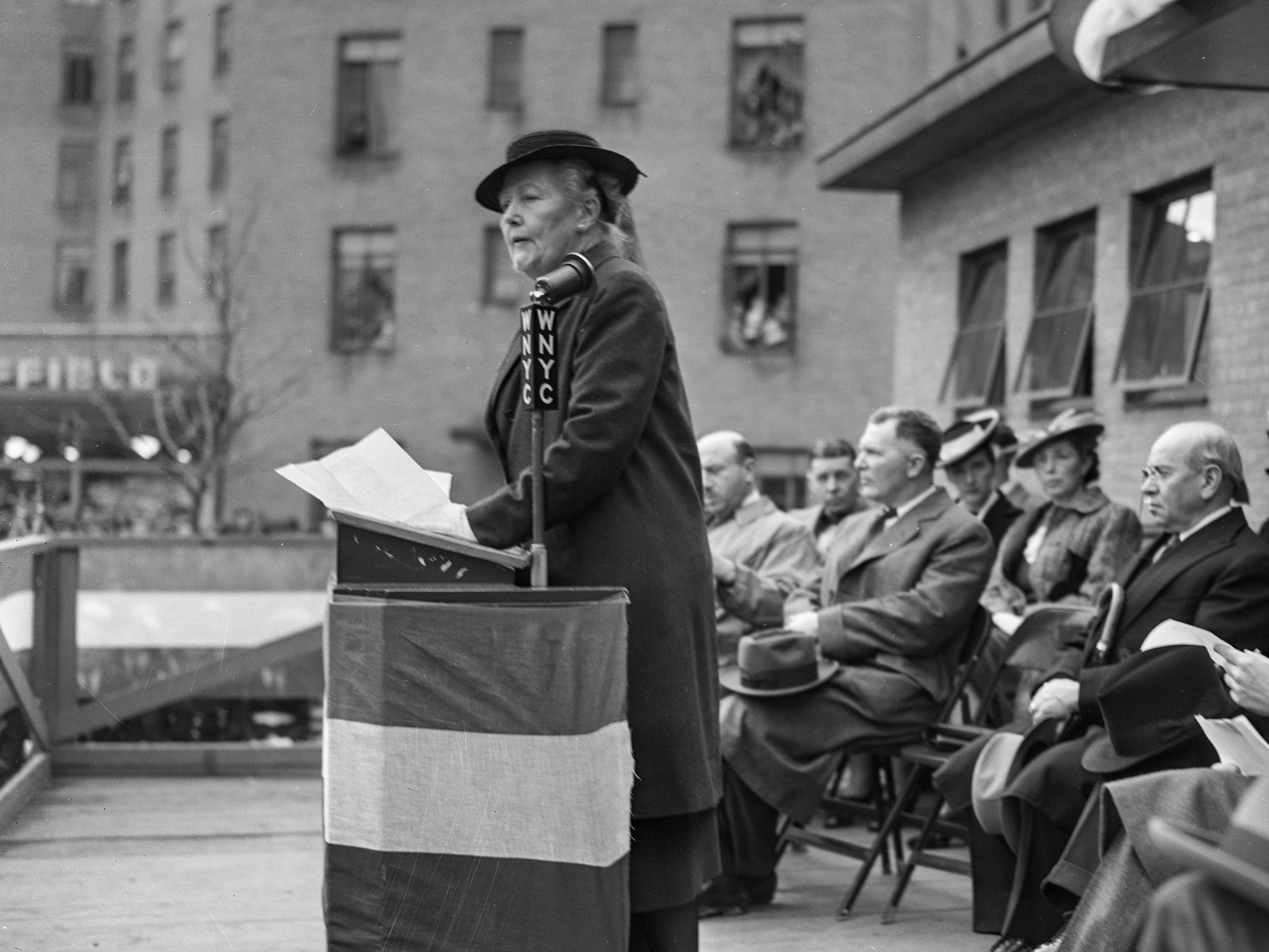
March is that month we look to forgotten women, those who slipped through the cracks when historians wrote their books and Hollywood turned out movies about the mysterious and the glamorous. Although Mary Kingsbury Simkhovitch was never featured in a movie, she earned plenty of headlines during her lifetime, as the founder of “the most important place in Greenwich Village” and the “mother of public housing.” She is also the founder of the National Housing Conference. Yet her name gets scant recognition today.
That Mary managed to do so much while financially supporting a family and raising two children is remarkable. By the mid-1930s, when First Lady Eleanor Roosevelt put her on a list of ten outstanding women in America, Time magazine was making her look ridiculous as the inept mother of an adult son involved in cryogenics experiments.
Mary’s early years showed no sign of her later activism. Born in 1867 just outside Boston, she attended local public schools, then commuted to Boston University for a degree in Latin. After graduating in 1890, she did what most female college grads did at the time—she continued living with her parents. Suffering from hair loss, headaches and what she called “rheumatism” she lived almost as an invalid for nearly two years. Then she took a temporary job teaching Latin in a nearby school and that gave her little satisfaction. She hated it so much she said she sometimes threw away students’ papers rather than grade them.
In September 1894, when she was about to celebrate her 27th birthday, she made an important change. On the recommendation of a friend, she moved out of her family’s home and into a boarding house for academics in Cambridge, and she enrolled at the Harvard Annex (now called Radcliffe). Along with well-traveled, sophisticated women (like Gertrude Stein) she took courses with Harvard professors in subjects new to her, such as the economic history of Europe and the status of women.
At the end of that year, Mary made another important decision. With the $600 fellowship she won, she decided to go to Europe and study at the University of Berlin. One of only two American women enrolled, she took a course in socialism with Dr. Adolph Wagner that changed her thinking. His “municipal socialism” made housing in dense urban areas part of the infrastructure, like sewers and water pipes, to be paid for by public funds. Mary admired the housing projects in Berlin, and she found the city’s solution “visionary, exhilarating, imaginative and well worth copying.” The first article she published called for “State intervention.”
Vladimir Simkhovitch, a Russian seven years her junior, attended some of the same classes as Mary in Berlin, and the relationship turned quickly to courtship. He remained behind when she returned to the U.S. in September 1896, and then two years later wrote that he was coming to marry her. He would arrive penniless, he warned her, and for the first years of their marriage she would be the sole support of the family.
The “state intervention” that Mary called for in the 1898 article never left her agenda, but she knew she had to wait for public opinion to catch up with her thinking. Even ardent housing reformers insisted that the solution was more regulation of housing and that private investment would suffice. Public funding of roads and schools was justifiable, but people should build their own houses. To put public money into housing was “un-American” and “Socialistic.”
To change that opinion, Mary resorted to forms of persuasion she knew best. She mounted exhibitions of photos showing overcrowded rooms, with laundry over the table, and she added charts showing the high rate of disease and death in such conditions. She gave speeches and assisted researchers in publishing books on the high percentage of family income that went to rent.
To focus national attention on the subject, Mary Simkhovitch and Florence Kelley formed a committee that cosponsored in 1909 the first national convention ever held on City Planning and the Problem of Congestion. Those who attended the Washington, DC convention heard Simkhovitch, the only female speaker, describe the overcrowded tenements on her street in New York, with families doubling up and tiny apartments serving for both living and home manufacture. Joseph Cannon, Speaker of the House of Representatives, admitted that he had never paid much attention to women speakers until he heard her.
All the speeches, exhibitions, and books on the maladies of urban congestion failed to change minds about public funding of housing until a mammoth economic downturn began in late 1929. As joblessness spiraled in the Great Depression, huts sprang up along city streets and the contents of entire households littered the sidewalks. Simkhovitch perceived a change in public opinion, and in late 1931, she invited a small group of like-minded friends to Greenwich House to plan a course of action. Calling themselves the National Public Housing Conference, they chose her as their president. With the inauguration of Franklin D. Roosevelt in March 1933 and the prospect of a huge economic boost from congress, she took a train to Washington to present her case to a special caucus of Democrats. She didn’t ask for mammoth amounts. A “wedge” would suffice.
The National Industrial Recovery Act of 1933 provided that cities with agencies in place to use the money could receive federal funds to demolish slums and erect new housing. In early 1934 newly elected Mayor Fiorello LaGuardia named Simkhovitch to a five-member New York City Housing Authority. She was the only female, and she served as vice chairman for 14 years, with a key part in dozens of public housing projects, beginning with First Houses, which opened in December 1935.
All the while she was helping decide on early New York projects, Mary kept working to make such funding permanent. She gave radio talks and appealed directly to both the president and First Lady, who were longstanding personal friends and had a summer home near hers. As each effort failed, President Roosevelt apologized to Simkhovitch and promised something would be forthcoming. In 1935, he sent a note to New York Senator Robert Wagner, requesting that “should much like to have a talk with you in regard to the more permanent aspects of slum clearance and low cost housing.” At the bottom of the note is a postscript to Mrs. Roosevelt – “This refers to Mrs. Simkhovitch’s letter.”
In 1937, in wording supplied by her National Public Housing Conference, the Wagner-Steagall Housing Act became law, establishing the United States Housing Authority and putting housing on the nation’s permanent agenda. As the number of public housing projects grew, one historian declared those were years “when public housing worked.” Shoddy construction, inadequate maintenance and other failures subsequently sullied the name “public housing” and even Simkhovitch’s National Housing Conference dropped “public” from its name.
In July 1952, the Wonder Woman comic book featured Simkhovitch in a three-page spread as a Wonder Woman of History. Diana Prince (Wonder Woman) writes at the end of the illustration, “during her 53 years as a leader in social work, Mary Simkhovitch concerned herself with such a great variety of social problems that it is astonishing she carried them all out so successfully.”
What continues to mark Mary Simkhovitch’s accomplishment is the continued operation of Greenwich House, the settlement she founded in 1902, and the National Housing Conference, started in 1931. Neither carries her name, but the National Housing Conference, the oldest and broadest coalition of affordable housing leaders in the country, continues her fight.