

In this issue
October 25, 2026
Issue 95-40
Regulatory Reform
- President Trump signs executive order on mortgage costs
- Treasury releases institutional investor proposed rule
Homelessness
Rental Housing
Production/Supply
NHC Update
Chart of the week
Regulatory Reform
President Trump signs executive order on mortgage costs
President Trump signed an executive order (EO) on October 22nd that seeks to lower costs for government backed mortgage loans. The EO, entitled, “Decreasing Housing Costs for the American People,” directs the Director of the Federal Housing Finance Agency (FHFA) to explore policies aimed at reducing costs for mortgages guaranteed by Fannie Mae and Freddie Mac (the Enterprises), and instructs the U.S. Department of Agriculture (USDA), Department of Veterans Affairs (VA), and U.S. Department of Housing and Urban Development (HUD) to take additional measures to address housing supply and affordability. Specifically, the order directs the FHFA Director to consider establishing a pilot program to proactively cancel mortgage insurance on qualifying loans when they reach 80% loan-to-value, as determined by automated valuation models or other mechanisms. It further instructs the Director to consider expansion of a title insurance pilot program currently being conducted at the Enterprises, as well as the reduction or elimination of loan-level pricing adjustments for some refinance loans. Finally, the order directs the USDA and VA to lower interest rates for single-family mortgages guaranteed through their direct loan programs and establishes a new task force on manufactured housing comprised of leadership from HUD, FHFA, USDA, VA, and the U.S. Department of Commerce.
The EO comes as mortgage rates remain above 7%, limiting refinancing opportunities and keeping homeownership out of reach for many prospective buyers. The administration’s approach seeks to reduce upfront financing expenses and monthly payments for borrowers. However, the scope of potential savings, implementation timelines, and legal authority for several proposed changes remain uncertain. FHFA Director Bill Pulte has hinted at potential further changes in recent social media posts and has also indicated that the agency is reviewing changes to LLPAs and the number of credit reports required for mortgage underwriting.

Treasury releases institutional investor proposed rule
The U.S. Department of the Treasury announced a proposed rule to implement provisions of the 21st Century ROAD to Housing Act that are intended to limit institutional investor participation in the single family housing market. The notice of proposed rulemaking (NPRM) provides proposed standards for build-to-rent programs, renovate-to-rent purchases, homeownership programs, and various other matters related to investor purchases and ownership of single family units.
“Under President Trump, this Administration continues to restore the path to affordable homeownership for millions of young and working families,” said Treasury Secretary Scott Bessent. “Treasury is working to ensure American families and workers have a fair shot at purchasing homes in their communities by increasing housing supply and limiting large institutional investors’ role in the market, while supporting a strong, stable housing market and avoiding unnecessary disruption.”
The institutional investor provision was widely debated during the bill’s consideration, with many housing organizations and advocates seeking a nuanced approach to new standards so that they do not discourage development of much needed additional housing supply. Comments on the proposed rule are due by November 23.
“Today’s proposed rule starts that process for reining in large institutional investors, but the work is far from done,” said Senator Elizabeth Warren (D-Mass.) in a statement. “Congress will be watching closely to ensure the Trump Administration finalizes strong final rules without loopholes for corporate landlords that drive up costs for renters and families trying to buy a home.”
Homelessness
Home Depot commits $1B to veterans housing
The Home Depot Foundation announced an expanded commitment to invest $1 billion in veteran causes by 2032, with a focus on addressing homelessness, improving housing conditions, and expanding access to stable, affordable housing. Since 2011, the Foundation has invested more than $650 million in veteran causes and helped improve more than 70,000 veteran homes and facilities. The announcement comes as nearly 33,000 veterans experience homelessness on any given night and more than 2.75 million live in inadequate housing, according to the Foundation. The new commitment will support innovative housing solutions, homelessness prevention, home repairs, and permanent supportive housing.
“We believe every veteran deserves a safe place to call home,” said Erin Izen, executive director of The Home Depot Foundation. “Our $1 billion commitment supports the partnerships and solutions needed to help more veterans move from uncertainty to long-term stability.”
The Foundation plans to expand partnerships with organizations testing new approaches to veteran housing insecurity, including the U.S.VETS Master Lease Program, which leases units directly from property owners to help veterans overcome rental barriers, and the Landlords, Organizations, and Veterans Engagement (LOVE) Fund, which helps cover security deposits and application fees. Additional investments will support renovations of transitional and permanent supportive housing, accessibility improvements, and modular housing construction for aging veterans.

The Housing Event You Won’t Want to Miss: Join Us December 8!
Join the National Housing Conference on December 8 at the National Press Club in Washington, D.C., for our annual Solutions for Affordable Housing convening. This premier event brings together policymakers, lenders, developers, advocates, researchers, housing providers, and other stakeholders to identify tangible, impactful, and achievable solutions that can move housing policy and practice forward.
This year’s sessions will tackle some of the most pressing issues facing affordable housing, including:
- Economic, political, and market forces shaping the year ahead.
- Challenges, opportunities, and solutions to expand access to housing.
- The impact of evolving mortgage finance policies and regulations on the housing market.
- What’s working to accelerate development and increase supply.
- Innovative approaches to expanding housing opportunities at the state level.
- Strategies to address labor shortages and strengthen the workforce.
- Emerging fair housing issues and challenges shaping the future of housing.
In-person Tickets – $400*
Virtual Tickets – $250*
*NHC members receive exclusive discounts to Solutions for Affordable Housing.
Please reach out to info@nhc.org for more information.
Sponsorship Opportunities Available
Elevate your organization’s profile and actively participate in the conversations that are shaping the future of housing by sponsoring NHC’s Solutions for Affordable Housing convening. We offer sponsorship levels tailored to fit every organization’s needs, starting at $1,000. Learn more about sponsorship opportunities here.


Rental Housing
Ginnie Mae aligns financing requirements for rural rental housing
Ginnie Mae announced changes to its mortgage-backed securities (MBS) program that expands financing access for affordable rental housing in rural communities. The agency will allow loans guaranteed through the U.S. Department of Agriculture’s (USDA) Section 538 Guaranteed Rural Rental Housing Program to be pooled into Ginnie Mae securities at up to 80% of total development costs, an increase from the previous 70% limit. The change aligns Ginnie Mae’s requirements with USDA Rural Development’s recent increase in the maximum loan-to-cost ratio, which covers construction and permanent financing.
“Ginnie Mae supports efforts to provide reliable sources of liquidity for rural multifamily housing,” said Joe Gormley, Ginnie Mae President. “This update lets lenders and developers structure Section 538 transactions more efficiently and strengthens the connection between federal housing guarantees and the nation’s secondary mortgage market, while preserving the integrity of the Ginnie Mae guaranty.”
The change goes into effect for loans submitted on or after November 1, 2026.

Production & Supply
Housing construction slows as builder confidence falls to lowest level in more than a decade
New market data show continued challenges for housing production and affordability as rising mortgage rates, elevated construction costs, and weakening buyer demand weigh on the industry. The National Association of Home Builders (NAHB)/Wells Fargo Housing Market Index fell to its lowest level since June 2012. The index measures builder confidence in the market for newly built single-family homes. Forty-three percent of builders reported cutting home prices in October, while 65% offered sales incentives to attract buyers, reflecting continued affordability pressures on prospective homebuyers.
“Housing remains squeezed by supply-side constraints and significant affordability challenges,” said Robert Dietz, NAHB’s chief economist in a release. “Demand persists, but higher mortgage rates, elevated construction costs and weaker consumer confidence are keeping more buyers on the sidelines.”
Meanwhile, new Census Bureau data showed single-family housing starts declined 4.6% in September to an annualized rate of 859,000 units, while single-family building permits fell 4% to their lowest level since March 2023. The slowdown raises concerns about the longer-term housing supply outlook, as fewer new homes entering the development pipeline could prolong affordability challenges even as builders lower prices and offer incentives to attract buyers.

NHC Update
Renew or join NHC today to unlock exclusive member benefits!
Join or renew your NHC membership for 2027 by October 31 to take advantage of exclusive, limited-time benefits! Depending on your membership level, enjoy complimentary registration to upcoming NHC convenings, discounts on additional virtual tickets, and special recognition opportunities. New members also receive complimentary membership for the remainder of 2026. Don’t miss out on these added benefits—learn more and renew or join today!
Chart of the week: Two-bedroom rentals move further out of reach since 2020
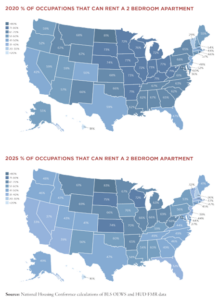
Rental affordability changes highlighted in NHC’s latest report, Priced Out: When a Good Job Isn’t Enough, show deteriorating affordability across the country from 2020-2025. The analysis considers occupation-metro combinations, comparing median wages to fair market rents. In total, 45,833 occupation-metro combinations could comfortably afford a 2-bedroom apartment in 2025, compared to 51,822 in 2020. New Hampshire, Nevada, and Idaho experienced a decline of approximately 20 percentage points or more. Regionally, the South Atlantic Region showed the largest declines, followed closely by the Mountain region. Across the country, 48% of occupation-metro combinations are unable to afford 2-bedroom apartments without being cost-burdened.
What we’re reading
A new report from the Center for Responsible Lending’s (CRL) Julian Bond Institute reveals that it takes families twice as long to save for a down payment to purchase a home as it did in 2019. The report, which updates CRL research released in 2019, examined the length of time required for a typical family saving at today’s national savings rate to accumulate sufficient funds for a down payment and closing costs to purchase a starter home.
An NPR article explores how Gen Z candidates from both parties are making housing affordability a campaign priority. Drawing on their own experiences with high housing costs, candidates in Connecticut and Montana are pushing proposals ranging from zoning changes and renter protections to incentives for starter-home construction.
The Bipartisan Policy Center published an issue brief on Build America, Buy America and how its requirements are affecting affordable housing development. Developers report higher costs, construction delays, and compliance burdens tied to domestic sourcing challenges and the U.S. Department of Housing and Urban Development’s (HUD) slow, uncertain waiver process. The brief outlines potential reforms, ranging from clearer compliance standards and streamlined waivers to exemptions for affordable housing.
An article from Reuters reports how a federal appeals court largely kept in place an order blocking HUD’s overhaul of the Fair Housing Initiatives Program while the government’s appeal proceeds. The proposed changes would redirect funding away from the network of nonprofit organizations that help investigate housing discrimination and enforce fair housing protections.