
In this issue
October 18, 2026
Issue 95-39
Regulatory Reform
- Housing groups, lawmakers warn proposed CRA changes could reduce affordable housing investment
- GAO report finds HUD workforce declined 29%
Production & Supply
Economic Outlook
Chart of the week
Regulatory Reform
Housing groups, lawmakers warn proposed CRA changes could reduce affordable housing investment
Housing stakeholders and lawmakers raised concerns regarding proposed changes to the Community Reinvestment Act (CRA) issued by two of the three federal banking regulators, with many groups submitting comments opposing the proposal. The proposal would weaken incentives for banks to invest in underserved communities, including through affordable housing and community development initiatives. Specifically, it would raise the threshold for large banks to $10 billion in assets, moving more than 1,500 banks out of the more rigorous CRA examination framework required of the nation’s largest banking institutions. Critics warn that the changes could reduce incentives for banks to invest in affordable housing, including through the Low-Income Housing Tax Credit (LIHTC), and redirect capital away from low- and moderate-income communities. Additionally, industry analysis indicates that changes would have a disproportionate impact on rural communities.
More than 475 housing and community development organizations signed a letter led by the National Association of Affordable Housing Lenders (NAAHL) urging the Office of the Comptroller of the Currency (OCC) and the Federal Deposit Insurance Corporation (FDIC) to preserve meaningful community development requirements should any changes be made to existing CRA regulations.
“CRA is an irreplaceable policy that harnesses the power of the U.S. banking system to expand access to housing and economic opportunity,” said Sarah Brundage, president and CEO of NAAHL. “Blunt changes to CRA may have unintended consequences. With any updates to CRA, we should ensure that we are enhancing the outcomes of CRA, not suppressing them.”
The National Housing Conference (NHC) submitted comments on the proposed rule, urging that the proposed regulation be withdrawn and suggesting that, “Given the importance of CRA to communities, financial institutions, and local economies nationwide, any significant revisions should include all three federal banking regulators, robust public engagement, and careful congressional oversight.”
A group of Senate Democrats also sent a letter to regulators calling for the proposal to be rescinded.
“This proposal undermines the recently-passed bipartisan 21st Century ROAD to Housing Act—the most comprehensive law passed in over three decades to address the nation’s housing crisis. Your agencies should be working with Congress and stakeholders to strengthen and incentivize investments in communities, not advancing proposals that would reduce private-sector investments in community development and affordable housing,” wrote the Senators. “We urge the OCC and FDIC to immediately withdraw this proposed rule.”

GAO report finds HUD workforce declined 29%
A new report from the Government Accountability Office (GAO) found that HUD reduced its workforce by 29% between December 2024 and December 2025, raising concerns about the agency’s ability to administer housing assistance programs and enforce fair housing protections. The reductions were largely achieved through deferred resignation programs, with more than half of departing employees having served at HUD for at least 10 years, including 41% with more than 20 years of experience. GAO also found that only 32 of HUD’s 68 active grant programs made new awards in fiscal year 2025, while the department terminated approximately 21% of its active contracts, valued at $367 million. Representatives from 20 housing stakeholder organizations interviewed by GAO reported confusion, delays, and operational disruptions, including reduced fair housing services during funding gaps and delays in property inspections. HUD did not respond to GAO’s requests for information during the review.
The findings prompted Sen. Elizabeth Warren (D-Mass.), ranking member of the Senate Banking Committee, to send a letter to HUD Secretary Scott Turner and Assistant Secretary Craig Trainor questioning the department’s enforcement of federal civil rights and fair housing laws. Warren cited whistleblower allegations of political interference, staffing reductions, and restrictions on enforcement activities within HUD’s Office of Fair Housing and Equal Opportunity. HUD maintains that it remains committed to enforcing federal fair housing laws and describes its restructuring efforts as intended to improve efficiency and streamline operations. Warren requested additional information from HUD by Oct. 28.
Production & Supply
HUD expands financing for Build-to-Rent housing and outlines FHA modernization priorities
The U.S. Department of Housing and Urban Development (HUD) announced new Federal Housing Administration (FHA) policies expanding access to federally insured financing for Build-to-Rent communities, an effort aimed at increasing rental housing supply and reducing barriers to development. Effective immediately, the policy allows communities consisting of single-family homes, duplexes, and triplexes, including manufactured housing, to qualify for FHA financing under the Section 221(d)(4) program for new construction and Section 223(f) multifamily mortgage insurance programs. Eligible developments must contain at least five dwelling units on a contiguous site and will be treated under the same terms and conditions as traditional multifamily rental properties, subject to program requirements.
“We’re eliminating barriers to spur development, expand rental options, and improve housing affordability for hardworking American families,” said HUD Secretary Scott Turner.
The announcement comes as HUD leadership outlined broader efforts to increase lender participation and expand housing production. Matt Jones, HUD’s deputy assistant secretary for single-family housing and nominee for FHA commissioner, emphasized the need to simplify program requirements, reduce origination and servicing costs, and provide greater regulatory certainty to attract more lenders at a recent industry event. Ginnie Mae President Joe Gormley, who is also performing the duties of the Assistant Secretary for Housing and Federal Housing Commissioner on an interim basis, highlighted efforts to expand liquidity in the mortgage servicing market and encourage investment in manufactured housing. Gormley cautioned that manufactured housing reforms alone would not resolve the nation’s housing supply challenges but could encourage additional private investment.

The Housing Event You Won’t Want to Miss: Join Us December 8!
Join the National Housing Conference on December 8 at the National Press Club in Washington, D.C., for our annual Solutions for Affordable Housing convening. This premier event brings together policymakers, lenders, developers, advocates, researchers, housing providers, and other stakeholders to identify tangible, impactful, and achievable solutions that can move housing policy and practice forward.
This year’s sessions will tackle some of the most pressing issues facing affordable housing, including:
- Economic, political, and market forces shaping the year ahead.
- Challenges, opportunities, and solutions to expand access to housing.
- The impact of evolving mortgage finance policies and regulations on the housing market.
- What’s working to accelerate development and increase supply.
- Innovative approaches to expanding housing opportunities at the state level.
- Strategies to address labor shortages and strengthen the workforce.
- Emerging fair housing issues and challenges shaping the future of housing.
In Person Tickets – $400*
Virtual Tickets – $250*
*NHC members receive exclusive discounts to Solutions for Affordable Housing.
Please reach out to info@nhc.org for more information.
Sponsorship Opportunities Available
Elevate your organization’s profile and actively participate in the conversations that are shaping the future of housing by sponsoring NHC’s Solutions for Affordable Housing convening. We offer sponsorship levels tailored to fit every organization’s needs, starting at $1,000. Learn more about sponsorship opportunities here.


Economic Outlook
Inflation accelerates to 3.7%
Inflation accelerated in September, with the Consumer Price Index (CPI) rising 3.7% year-over-year, up from 3.4% in August, according to the Bureau of Labor Statistics (BLS). Consumer prices increased 0.6% over the month, driven largely by rising energy costs, with gasoline prices increasing 34.2% annually. Shelter costs rose 0.4% in September, up from 0.3% in August, and increased 3.2% over the past year. Core inflation, which excludes food and energy, rose 2.6% annually, up from 2.4% in August.
The report raised concerns that persistent inflation could prompt the Federal Reserve to raise interest rates sooner than expected, potentially keeping mortgage rates elevated and delaying improvements in housing affordability. Freddie Mac reported mortgage rates at 7.4%, emphasizing renewed concerns about homeownership affordability following a brief reprieve from elevated interest rates earlier this year.
Sam Williamson, senior economist at First American, warned that the higher-than-expected inflation reading could prompt the Federal Reserve to increase rates in October, following its first increase in three years last month. Williamson noted that elevated borrowing costs could exacerbate the mortgage rate lock-in effect, limiting housing inventory and offsetting improvements in purchasing power from rising incomes and cooling home prices.


Chart of the Week: Housing affordability eroded for workers across the U.S.
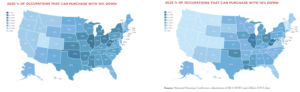
NHC’s latest report, Priced Out: When a Good Job Isn’t Enough, highlights changes in housing affordability from 2020 to 2025 for occupation-metro combinations nationwide. Maps showing the percentage of occupation-metro combinations that can afford to purchase a home with a 10% down reveal widespread declines in affordability, with particularly sharp drops across the Midwest. Illinois saw its share fall from 71% in 2020 to 35% in 2025, while Oklahoma, Kansas, and West Virginia experienced declines of over 30 percentage points. In 2020, 57% of occupation-metro combinations in Michigan could afford to purchase a typically priced home with a 10% down payment, but only 22% could do so in 2025. Texas experienced a decline from 46% in 2020 to 19% in 2025. The data underscore how rising housing costs are outpacing wages, pushing homeownership increasingly out of reach for workers across the country.
What we’re reading
A new report from NAAHL’s Center for Affordable Housing Lending, The Next Playbook: Bringing Back the Starter Home, examines the shrinking supply of entry-level homes, finding that new construction of homes under 1,400 square feet fell from 40% of total annual production in 1980 to 9% today. The report outlines five priorities to build more starter homes and calls for swift implementation of the 21st Century ROAD to Housing Act and passage of the Neighborhood Homes Investment Act.
The Federal Reserve’s 2025 Survey of Consumer Finances details the economic conditions of families across the U.S. Findings show that inflation-adjusted median family income rose 7% between 2022 and 2025, while median net worth increased by 2%. Homeownership held steady at 66%, but the share of families spending more than 40% of income on debt payments increased from 6.5% to 8.6%.
Habitat for Humanity’s report, Home at What Cost?, draws on responses across 22 countries to examine how housing pressures affect everyday well-being, spending, and future plans. Three-quarters of respondents reported cutting at least one expense to cover housing costs in the past year, including 33% who reduced food spending, 32% who tapped savings or emergency funds, and 13% who postponed or avoided medical care.