

In this issue
November 8, 2026
Issue 95-42
Community and Economic Development
Regulatory Updates
Chart of the Week
Community and Economic Development
Treasury and IRS designate new Opportunity Zones nationwide
The U.S. Department of the Treasury and the Internal Revenue Service (IRS) announced the designation of thousands of Qualified Opportunity Zones across the United States. Building upon the $110 billion in private-sector investment since the program’s creation, the new designations are intended to encourage long-term private investment, job creation, and economic development in underserved communities. Of the 6,576 designated census tracts, 2,594 are located in rural areas, accounting for more than 39% of the total. A complete list and interactive map of the designated Opportunity Zones (OZs) are available through the Community Development Financial Institutions Fund.
The announcement follows OZ changes enacted under the Working Families Tax Cuts Act, which permanently extended the Opportunity Zone tax incentive, established a process for redesignating zones every 10 years, and introduced enhanced incentives for investment in eligible rural communities. The updated program provides a rolling five-year deferral on capital gains taxes and a 10% basis step-up, increasing to 30% for qualifying rural investments. New eligibility requirements also lower the median family income threshold for census tracts from 80% to 70%, resulting in 25% fewer designated tracts compared to the 8,764 zones established in 2018. Treasury and the IRS identified more than 25,000 eligible census tracts nationwide earlier this year and began accepting nominations from governors and the mayor of Washington, D.C., in July. The new designations will take effect Jan. 1, 2027, and remain in place for 10 years.
“The Working Families Tax Cuts permanently renewed and strengthened Opportunity Zones, giving investors, entrepreneurs, and local leaders the long-term certainty they need to commit capital to communities that have been overlooked for too long,” said Treasury Secretary Scott Bessent. “Today’s announcement of the new designations will help direct private investment to these communities, expand economic opportunity, support job creation, and unlock long-term growth in these communities across the country.”


HUD launches LIHTC Express Lane
The U.S. Department of Housing and Urban Development (HUD) announced the Low-Income Housing Tax Credit (LIHTC) Express Lane Initiative, which aims to accelerate the approval process for Federal Housing Administration (FHA)-insured construction loans for qualifying affordable rental housing developments financed under FHA’s Section 221(d)(4) program.
Outlined in a Mortgagee Letter, the initiative builds on previous HUD pilot programs and incorporates feedback from industry stakeholders. Key changes include eliminating the previous 200-unit project size limit, expanding eligibility to include developments financed with 4% credits, and removing certain financing restrictions. Projects using 9% tax credits also remain eligible.
The initiative maintains a targeted 30-day timeline for firm commitment decisions and introduces several changes intended to reduce administrative delays. These include priority scheduling for required concept meetings, greater flexibility in the timing of tax credit equity contributions, and allowing certain construction documents and third-party reports to be submitted closer to closing.
Participation is limited to experienced development teams that meet HUD’s financial and performance requirements. HUD emphasized that the initiative maintains existing underwriting and risk standards while focusing on reducing processing times for qualifying transactions. The new process is effective immediately, with HUD planning to use feedback from participating projects to inform future improvements to its multifamily financing programs.

The Housing Event You Won’t Want to Miss:
Join Us December 8!
Join the National Housing Conference at the National Press Club in Washington, D.C., for our annual Solutions for Affordable Housing convening. This premier event brings together policymakers, lenders, developers, advocates, researchers, housing providers, and other stakeholders to identify tangible, impactful, and achievable solutions that can move housing policy and practice forward.
This year’s sessions will tackle some of the most pressing issues facing affordable housing, including:
- Economic, political, and market forces shaping the year ahead.
- Challenges, opportunities, and solutions to expand access to housing.
- The impact of evolving mortgage finance policies and regulations on the housing market.
- What’s working to accelerate development and increase supply.
- Innovative approaches to expanding housing opportunities at the state level.
- Strategies to address labor shortages and strengthen the workforce.
- Emerging fair housing issues and challenges shaping the future of housing.\
In Person Tickets – $400*
Virtual Tickets – $250*
*NHC members receive exclusive discounts to Solutions for Affordable Housing.
Please reach out to info@nhc.org for more information.
Sponsorship Opportunities Available
Elevate your organization’s profile and actively participate in the conversations that are shaping the future of housing by sponsoring NHC’s Solutions for Affordable Housing convening. We offer sponsorship levels tailored to fit every organization’s needs, starting at $1,000. Learn more about sponsorship opportunities here.

Regulatory Updates
HUD announces public housing accountability dashboard
HUD launched a nationwide Public Housing Authority (PHA) Accountability Dashboard, providing public access to housing authority performance and funding data. Users can search by housing authority, state, or nationwide to view assessment scores, performance designations, public housing units, Housing Choice Vouchers, utilization rates, and budget authority. The dashboard also allows users to generate reports identifying agencies with troubled or substandard ratings, those under receivership or monitorship, and those facing funding shortfalls. The tool is intended to strengthen transparency by making it easier for residents, local officials, advocates, and researchers to compare housing authority performance across states and regions.
“Every family and individual in federally assisted housing deserves a safe home and a well-managed housing authority,” said HUD Secretary Scott Turner. “The PHA Accountability Dashboard will provide the public with a clear view of service quality, reinforcing public trust and ensuring PHA performance is held to the highest standard.”
According to HUD, 77 housing authorities have moved out of troubled status since January 2025, while seven have been declared in substantial default. By bringing performance and funding information into one public tool, the dashboard gives stakeholders a clearer view of how agencies are administering housing assistance and using available resources.


HOTMA compliance delayed to 2028
HUD has announced another extension of the mandatory compliance deadline for Sections 102 and 104 of the Housing Opportunity Through Modernization Act of 2016 (HOTMA), giving multifamily housing owners until January 1, 2028, to fully comply with the final rule.
The extension applies to multifamily housing owners participating in programs covered under HUD Notice H 2023-10, which outlines implementation requirements for HOTMA. The compliance deadline was originally set for January 1, 2025, and had previously been extended to January 1, 2027.
Under the revised timeline, affected multifamily housing owners must comply with the HOTMA final rule and updated documentation requirements for income certifications effective on or after January 1, 2028. The new notice revises the compliance date without changing the underlying requirements. Consequently, through January 1, 2028, owners will not be penalized for HOTMA-related tenant file errors during Management and Occupancy Reviews.

Chart of the week: Home equity helps balance family needs and debt across generations
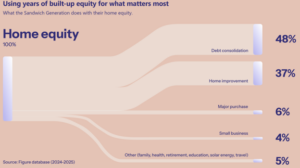
An analysis from Figure shows that debt consolidation accounts for 48% of reported home equity uses among the sandwich generation, defined as adults generally aged 40 to 60 who are supporting children and caring for aging parents while planning for their own futures. Home improvements follow at 37%, while major purchases, small businesses, and other uses account for the remaining 15%. In Figure’s analysis of home equity line of credit applications from 2024-2025, the sandwich generation had the highest average monthly debt obligations of any age group at $5,350. The findings highlight the tension between homeownership as a source of generational wealth and the financial pressures that lead families to borrow against it to manage immediate needs.
What we’re reading
HousingWire examined how the midterm elections could shape housing policy, from newly elected governors’ plans to expand housing supply to voter-approved financing measures. Proposals include zoning changes, streamlining permitting, and expanding down payment assistance, while approved ballot measures address housing bonds and property taxes. The results put housing affordability on the agenda across multiple levels of government, with implementation determining how those commitments translate into more homes and expanded access to homeownership.
The Federal Housing Finance Agency (FHFA) Office of Inspector General warns in its semiannual report to Congress that an approximately 64% reduction to its fiscal 2027 budget will severely limit its oversight capacity. The watchdog says the cuts will force it to shut down its national criminal enforcement program, reduce staff, and eliminate its Office of Evaluations. The report also details how FHFA’s restrictions on access to Fannie Mae and Freddie Mac records delayed three reviews of multifamily lending oversight, with funding cuts further jeopardizing their completion. OIG characterized this refusal as “unprecedented.”
The Pew Charitable Trusts published an article on the one-third of states that enacted significant housing reforms in 2026, including seven that adopted their first major changes. These bipartisan efforts expand opportunities for accessory dwelling units, starter homes, and apartments while reducing parking requirements, streamlining permitting and modernizing building codes. Together, the reforms reflect growing state-level efforts to address housing shortages by changing rules that limit construction and increase development costs.