

In this issue
November 22, 2026
Issue 95-44
Congressional Actions
- Senate releases FY 2027 HUD appropriations proposal
- Matt Jones’ FHA nomination advances through committee
- Bipartisan lawmakers urge HUD to streamline BABA waivers
HUD Updates
- FHA supports more than 935,000 homebuyers in FY 2026
- Lawsuit challenges HUD’s mixed-status household rule
Housing Supply
Chart of the Week
Congressional Actions
Senate releases FY 2027 HUD appropriations proposal
The Senate Appropriations Committee released its final five fiscal year (FY) 2027 appropriations bills, including the Transportation, Housing and Urban Development, and Related Agencies (THUD) bill, which proposes approximately $77 billion in funding for the U.S. Department of Housing and Urban Development (HUD). The proposal would increase funding for several major affordable housing programs, including $36.8 billion for Housing Choice Voucher renewals, $1.8 billion above FY 2026 levels, and $19.7 billion for Project-Based Rental Assistance, an increase of $1.2 billion. It would also provide $4.9 billion for the Public Housing Operating Fund, $3.2 billion for the Capital Fund, and $4.7 billion for Homeless Assistance Grants. Funding for the HOME Investment Partnerships Program would increase by $250 million to $1.5 billion, while Community Development Block Grants (CDBG) funding would remain level at $3.3 billion. The proposal does not include funding for the Choice Neighborhoods or Jobs Plus programs.
The proposal also includes several provisions aimed at reducing administrative burdens and strengthening congressional oversight of HUD programs. Notably, it would exempt FY 2027 and prior-year funding for several programs from Build America, Buy America (BABA) requirements, including HOME, CDBG, public housing operating and capital funds, and Native American housing programs. The legislation would also require HUD to notify congressional appropriators before withdrawing, terminating, or rescinding grant awards, and includes provisions addressing fair housing enforcement, rulemaking procedures, and public housing administration. The legislation has not yet advanced through committee and will require further congressional negotiations before final passage.


Matt Jones’ FHA nomination advances through committee
The Senate Committee on Banking, Housing, and Urban Affairs voted along party lines,13-11, to advance Matthew Jones’ nomination to serve as Assistant Secretary for Housing and Federal Housing Administration (FHA) Commissioner at HUD. Jones, who currently serves as HUD’s Deputy Assistant Secretary for Single Family Housing, would oversee FHA’s single family, multifamily, and healthcare mortgage insurance programs, as well as housing counseling and manufactured housing programs if confirmed by the full Senate. He would replace Ginnie Mae President Joe Gormley, who is currently performing the delegable duties of the Assistant Secretary for Housing and Federal Housing Commissioner on an interim basis following Frank Cassidy’s departure earlier this year. Jones previously served as Associate Vice President of Government Housing Finance at the Mortgage Bankers Association (MBA) and as Senior Counsel for the Senate Banking and Finance committees.
During his October confirmation hearing, Jones emphasized expanding housing supply, reducing regulatory costs, and improving access to homeownership. He highlighted FHA’s efforts to streamline more than 150 program requirements, expand manufactured housing opportunities, and modernize mortgage underwriting through the adoption of additional credit scoring models beginning in 2027. Jones also discussed coordinating FHA multifamily financing with Low-Income Housing Tax Credits to support affordable rental housing development.
The nomination has received support from housing industry organizations, including NHC, MBA, and the National Association of REALTORS®, which have emphasized Jones’ housing finance experience and commitment to improving FHA programs.

Bipartisan lawmakers urge HUD to streamline BABA waivers
A bipartisan group of 18 House lawmakers sent a letter to U.S. Department of Housing and Urban Development (HUD) Secretary Scott Turner and Office of Management and Budget (OMB) Made in America Office Director Michael Stumo urging reforms to the Build America, Buy America (BABA) waiver process. Led by Reps. Maggie Goodlander (D-N.H.) and Mike Flood (R-Neb.), the lawmakers warned that lengthy and duplicative waiver requirements are delaying affordable housing construction, increasing development costs, and undermining the law’s domestic manufacturing objectives. According to the letter, approximately 3,500 BABA waivers have been approved across the federal government, but only 29 HUD waivers had been approved as of October 2026, with some requests taking months or more than a year to process.
The lawmakers recommended establishing product-specific or category-based waivers for construction materials with demonstrated domestic supply shortages, streamlining internal review procedures, and improving coordination between HUD and OMB. They said HUD’s recent Request for Information on domestic sourcing challenges could help identify products that consistently require waivers, reducing the need for developers to submit repetitive applications.
The letter emphasized that approval delays increase financing and land carrying costs, expose projects to rising construction expenses, and can jeopardize Low-Income Housing Tax Credit (LIHTC) compliance deadlines. The lawmakers argued that targeted, time-limited waivers would allow affordable housing developments to proceed while maintaining incentives for domestic manufacturing.

Less Than 50 Seats Remaining!
Join the National Housing Conference at the National Press Club in Washington, D.C., for our annual Solutions for Affordable Housing convening. This premier event brings together policymakers, lenders, developers, advocates, researchers, housing providers, and other stakeholders to identify tangible, impactful, and achievable solutions that can move housing policy and practice forward.
This year’s sessions will tackle some of the most pressing issues facing affordable housing, including:
- Economic, political, and market forces shaping the year ahead.
- Challenges, opportunities, and solutions to expand access to housing.
- The impact of evolving mortgage finance policies and regulations on the housing market.
- What’s working to accelerate development and increase supply.
- Innovative approaches to expanding housing opportunities at the state level.
- Strategies to address labor shortages and strengthen the workforce.
- Emerging fair housing issues and challenges shaping the future of housing.\
In Person Tickets – $400*
Virtual Tickets – $250*
*NHC members receive exclusive discounts to Solutions for Affordable Housing.
Please reach out to info@nhc.org for more information.
Sponsorship Opportunities Available
Elevate your organization’s profile and actively participate in the conversations that are shaping the future of housing by sponsoring NHC’s Solutions for Affordable Housing convening. We offer sponsorship levels tailored to fit every organization’s needs, starting at $1,000. Learn more about sponsorship opportunities here.


HUD Updates
FHA supports more than 935,000 homebuyers in FY 2026
The U.S. Department of Housing and Urban Development (HUD) released the Federal Housing Administration’s (FHA) fiscal year 2026 Annual Report to Congress on the Mutual Mortgage Insurance (MMI) Fund, highlighting the agency’s continued role in expanding access to homeownership and maintaining the financial stability of its mortgage insurance programs. FHA provided financing opportunities to more than 935,000 Americans during the fiscal year, including more than 530,000 first-time homebuyers. First-time buyers accounted for more than 83% of FHA-insured home purchase mortgages.
The report found that the MMI Fund maintained a capital ratio of 10.29%, down 1.18 percentage points from fiscal year 2025, but well above the statutory minimum of 2%. HUD attributed the decline in part to reduced revenue from newer mortgages following the 2023 mortgage insurance premium reduction. FHA also maintained insurance on 8.4 million single-family forward mortgages with more than $1.7 trillion in outstanding principal balances.
Following the report’s release, mortgage trade organizations renewed calls to reduce FHA mortgage insurance premiums, arguing that the MMI Fund is overcapitalized.
“Our members strongly believe that with the MMIF’s capital reserve ratio at 10.29% — more than five times the 2% statutory minimum — FHA should modestly reduce annual mortgage insurance premiums, lowering monthly payments for moderate- and lower-income homebuyers,” said Bob Broeksmit, president and CEO of the Mortgage Bankers Association. The Community Home Lenders of America called for an end to FHA’s life-of-loan mortgage insurance requirement as well.

Lawsuit challenges HUD’s mixed-status household rule
A coalition of Los Angeles residents and tenant advocacy organizations filed a lawsuit challenging the U.S. Department of Housing and Urban Development’s (HUD) recently finalized rule restricting housing assistance for mixed-status households. Filed in the U.S. District Court for the Central District of California, the lawsuit argues that the rule unlawfully eliminates longstanding protections allowing families with both eligible and ineligible members to live together in federally assisted housing while receiving prorated subsidies. The plaintiffs include People Organized for Westside Renewal (POWER), Union de Vecinos, and three Los Angeles County residents receiving HUD assistance. The lawsuit alleges that the rule violates the Administrative Procedure Act, the Fair Housing Act, and the U.S. Constitution by exceeding HUD’s statutory authority and failing to adequately account for the consequences for affected families.
The rule, scheduled to take effect Dec. 14, requires all household members to verify their eligible immigration status and limits continued prorated assistance. The plaintiffs cite estimates that 79,300 people nationwide live in affected households, including 36,000 eligible children, with California accounting for roughly 36% of these households. HUD itself estimates upfront implementation costs of $17 million to $33 million and an additional $311 million to $385 million in funding needed to maintain the same number of assisted households. The lawsuit seeks to delay implementation and ultimately invalidate the rule.
The lawsuit follows widespread opposition to the rule during the public comment period earlier this year, when more than 16,000 comments were submitted to HUD. NHC opposed the proposed rule in its entirety, warning that eliminating prorated assistance would increase homelessness, separate families, and impose significant administrative burdens on housing providers.
In its final rule, HUD acknowledged that the changes could increase housing insecurity for affected families but argued that redirecting assistance would benefit fully eligible households currently on waiting lists. HUD Secretary Scott Turner defended the policy as necessary to ensure federal housing assistance benefits only eligible individuals. Following the rule’s finalization, NHC President and CEO David Dworkin criticized the decision, stating that it undermines decades of bipartisan policy precedent balancing statutory compliance, family stability, administrative feasibility, and responsible use of federal housing resources.

Housing Supply
Multiple private sector groups announce funding initiatives for housing
Multiple private-sector organizations announced new investments and initiatives aimed at expanding affordable housing production, strengthening community development financing, and encouraging housing innovation. Airbnb launched a $1 million Housing Innovation Prize to support companies and nonprofits developing solutions to reduce housing construction costs and accelerate production. The competition builds on Airbnb’s $250 million Housing Accelerator, announced in September, which aims to unlock more than $5 billion in housing investment over the next decade through gap financing and support for housing policy reforms. The prize will be awarded annually for five years, with applications open through Dec. 11. NHC President and CEO David Dworkin will serve among the housing experts advising on the selection of winners.
Capital One and Opportunity Finance Network (OFN) announced a $45 million partnership to expand access to capital in low- and moderate-income communities through OFN’s network of nearly 500 Community Development Financial Institutions (CDFIs). The investment includes $30 million in debt capital and $15 million in philanthropic funding, which the organizations estimate could leverage up to $360 million in additional community development capital. The partnership advances Capital One’s broader $600 million commitment to CDFIs supporting affordable housing, small businesses, and consumer lending.

Chart of the week: Rents rise for the first time since 2023
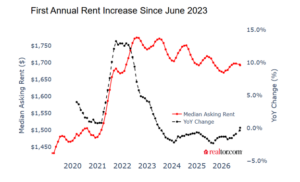
New research from Realtor.com shows that median asking rents increased year over year for the first time since June 2023, rising 0.1% to $1,692 in October across the nation’s 50 largest metropolitan areas. Despite more than three years of declining rents, asking rents remain 15% ($221) above pre-pandemic levels, though they are 4.6% ($82) below their August 2022 peak. Two-bedroom rents increased 0.3% year over year to $1,889, while studio rents continued to decline, falling 1.2%. The report attributes the prolonged period of declining rents largely to increased multifamily housing supply following the construction boom of 2021–2022. However, multifamily completions fell 26% year over year in the third quarter of 2026 to 330,000 units, while starts declined 9.2% to 403,000 units.
What we’re reading
Following the midterm elections, The New York Times’ The Daily looks at the policies Democrats could pursue to bring down everyday costs, emphasizing that housing is the main affordability concern for many families. The discussion considers the implications of the housing bill passed earlier this year, and the complications of housing as a local issue that could benefit from federal legislation that encourages the production of more affordable homes.
The National Low Income Housing Coalition released the second edition of its disaster toolkit for advocates and community-based organizations. The resource covers disaster response, short- and long-term recovery, resilience, and mitigation. The toolkit includes sample talking points and template letters to help organizations translate that guidance into advocacy.
In a recent speech, Federal Reserve Governor Michael Barr discussed how public-private partnerships can bring investment to communities underserved by traditional markets. His remarks highlight community development financial institutions, housing tax credits, and the Community Reinvestment Act. Together, these tools can help connect capital to affordable housing, small businesses, and local opportunities.