
In this issue
November 15, 2026
Issue 95-43
HUD Updates
Homelessness
Veterans Issues
Chart of the Week
HUD Updates
HUD moves forward with mixed-status changes
The U.S. Department of Housing and Urban Development (HUD) published a final rule that will enact changes to “mixed-status” households across the country, effectively eliminating the proration of rental assistance for households that include an ineligible member and forcing families to either forgo the rental assistance they receive or remove household members. The rule, Housing and Community Development Act of 1980: Verification of Eligible Status, eliminates a longstanding policy that families receiving housing assistance could include non-eligible residents but would receive a lesser, prorated subsidy amount to ensure that federal dollars only benefited those legally residing in the United States. An estimated 20,000 households utilizing HUD programs include a non-eligible member, with 80% of such households including children. NHC was among the 16,000 commenters who submitted feedback on the proposal in February, opposing the draft rule in its entirety and urging its withdrawal. Housing groups have warned that the changes could increase homelessness and housing instability by forcing families to choose between maintaining their housing assistance and remaining together. The final rule is expected to face legal challenges.
The final rule acknowledges these concerns, with HUD recognizing that the loss or reduction of housing assistance “could create significant financial hardship for some affected households.” HUD goes on to recognize commenters’ particular concerns for households including children and seniors, stating “while the rule may increase the risk of housing insecurity for some currently assisted households that include ineligible members, the assistance that is redirected would allow fully eligible households currently on waiting lists to receive it. Thus, any increase in housing insecurity for affected households that cannot remain in their unit would be counteracted to a certain extent by a decrease in housing insecurity experienced by the fully eligible households who would replace them.”
HUD’s Regulatory Impact Analysis estimates between $17 million and $33 million in upfront implementation costs for responsible entities and tenants. It also estimates that maintaining the same number of assisted households would require an additional $311 million to $385 million in funding. No funding mechanism was provided for these new costs.
“HUD’s concerns about immigration should be addressed through enforcement of existing laws, not by effectively evicting families who are here legally and creating expensive and burdensome processes for housing providers that are not capable of immigration enforcement,” said NHC President and CEO David Dworkin in a press release. “This is a step backward that undermines decades of bipartisan policy precedent that has balanced statutory compliance, family stability, administrative feasibility, and prudent stewardship of scarce federal housing resources.”


HUD details reorganization plan
HUD published a notice in the Federal Register outlining plans for a department-wide reorganization in response to significant workforce reductions over the past two years. The proposal would consolidate offices, streamline administrative functions, and restructure operations across HUD headquarters and field offices to align responsibilities with reduced staffing levels. According to HUD, staffing is nearly 35% below historical levels, leaving some offices constrained in their ability to carry out departmental objectives. A recent Government Accountability Office (GAO) report found that HUD lost approximately 3,200 employees, or 29% of its workforce, in 2025, with more than half of departing employees having at least a decade of experience at the agency. HUD said the changes are intended to improve operational efficiency without additional office closures, staff relocations, or reductions in employee pay.
The reorganization would affect nearly every major HUD program office. The Office of Public and Indian Housing would consolidate public housing responsibilities into one office and voucher programs into another, while the Office of Fair Housing and Equal Opportunity would transition to a centralized, function-based structure. The Federal Housing Administration (FHA) would reorganize its Single-Family Homeownership Centers by function rather than geography, with Philadelphia overseeing originations, Denver handling servicing, and Atlanta managing quality assurance. HUD would also consolidate community development grant administration, establish new data and market analysis functions within Ginnie Mae, and create a division focused on data and artificial intelligence. The Office of General Counsel would eliminate the distinction between headquarters and regional offices, consolidating legal services by program area.
The restructuring follows an earlier proposal that HUD published and subsequently withdrew in September. Although HUD expects the changes to improve program administration and reduce duplication, housing stakeholders have raised concerns about the agency’s ability to maintain essential services amid substantial staffing losses. The GAO report identified disruptions in communications with housing providers, delays in program administration, and reduced access to technical assistance and oversight. HUD’s notice states that the reorganization is not expected to produce significant additional costs or immediately quantifiable benefits beyond efficiencies associated with existing staffing reductions. Implementation is expected to proceed in 90 days and last through fiscal year 2027.

Seats Are Filling Fast! Register Today!
Join the National Housing Conference at the National Press Club in Washington, D.C., for our annual Solutions for Affordable Housing convening. This premier event brings together policymakers, lenders, developers, advocates, researchers, housing providers, and other stakeholders to identify tangible, impactful, and achievable solutions that can move housing policy and practice forward.
This year’s sessions will tackle some of the most pressing issues facing affordable housing, including:
- Economic, political, and market forces shaping the year ahead.
- Challenges, opportunities, and solutions to expand access to housing.
- The impact of evolving mortgage finance policies and regulations on the housing market.
- What’s working to accelerate development and increase supply.
- Innovative approaches to expanding housing opportunities at the state level.
- Strategies to address labor shortages and strengthen the workforce.
- Emerging fair housing issues and challenges shaping the future of housing.\
In Person Tickets – $400*
Virtual Tickets – $250*
*NHC members receive exclusive discounts to Solutions for Affordable Housing.
Please reach out to info@nhc.org for more information.
Sponsorship Opportunities Available
Elevate your organization’s profile and actively participate in the conversations that are shaping the future of housing by sponsoring NHC’s Solutions for Affordable Housing convening. We offer sponsorship levels tailored to fit every organization’s needs, starting at $1,000. Learn more about sponsorship opportunities here.


Homelessness
PIT count shows record decline in homelessness
HUD announced a 6.3% decrease in homelessness nationwide, the largest on record. The findings are based on the 2026 nationwide Point-in-Time (PIT) count, which identified 698,425 individuals experiencing homelessness on a single night in January. The decline marks the second consecutive year that homelessness has declined rather than increased based on PIT counts. According to an independent analysis from the National Alliance to End Homelessness, sheltered and unsheltered homelessness declined by 8% and 5% respectively, veteran homelessness declined by 8%, and chronic homelessness by 1%. While homelessness remains above pre-pandemic levels, the progress was lauded by advocacy and housing organizations.
“Over the past ten years, our communities have experienced economic shifts, public health emergencies, and housing crises. The numbers we see today stand as a testament to the resiliency of our communities amidst all this chaos,” said Adam Ruege, Principal of Policy and Evaluation at Community Solutions. “Even now – in the face of ongoing changes in federal policies and uncertainties around funding – communities are continuing to make progress.”
HUD credits new policies from the Trump Administration for the marked decrease, including support for local government responses to homelessness like encampment removal and increased immigration enforcement. HUD continues to denounce the Housing First approach and advocate for a Treatment First approach for people experiencing homelessness who also suffer from addiction or other mental health conditions.


Veterans Issues
GAO urges VA to strengthen oversight of partial claim program
The Government Accountability Office (GAO) released a report finding that the U.S. Department of Veterans Affairs (VA) has not developed a comprehensive plan to evaluate the effectiveness of its new Partial Claim Program, which helps veterans with delinquent VA-guaranteed mortgages avoid foreclosure. The program allows VA to reimburse mortgage servicers for missed payments and certain fees, bringing borrowers current on their loans. Borrowers repay the assistance without interest when they sell or refinance their homes, pay off the mortgage, or reach loan maturity. The program became effective in June, with mortgage servicers required to complete implementation by Nov. 28.
GAO acknowledged VA’s efforts to incorporate lessons from previous foreclosure prevention programs, including changes to documentation requirements, payment processes, and oversight procedures. However, the report found that VA has not established a comprehensive evaluation framework to determine whether the program successfully prevents foreclosures, reduces taxpayer costs, or improves outcomes for borrowers. GAO recommended that VA develop a plan identifying appropriate evaluation methods, data collection requirements, and performance measures to inform future program improvements. VA officials said they intend to begin analyzing program outcomes in December 2027.
In a separate announcement, VA highlighted a partnership with the National Association of REALTORS® to increase awareness of these benefits among eligible veterans, service members, and surviving spouses. The initiative aims to address misconceptions about VA-backed loans and equip real estate professionals with educational resources through VA’s Real Estate Professionals Home Loan Toolkit.

Chart of the week: Voters approve housing investments, reject zoning and permitting reforms
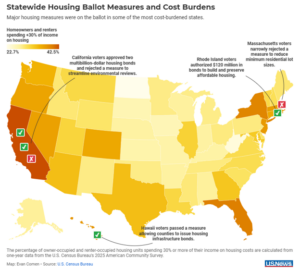
Housing policy was on the ballot in four states with voters considering six measures during the midterm elections, the largest number of statewide housing policy measures in two decades. Voters in four states facing some of the nation’s highest housing cost burdens—California, Rhode Island, Massachusetts, and Hawaii—approved four of the six housing policy measures. While voters approved measures supporting funding and financing options for housing programs in California, Rhode Island, and Hawaii, provisions focused on streamlining environmental reviews and reforming zoning changes were rejected in California and Massachusetts.
What we’re reading
An opinion piece in Next City proposes the U.S. establish a National Housing Data Authority to address fragmented, inconsistent, and inaccessible housing data across the country. The proposal calls for a federal or quasi-federal entity to coordinate housing data collection, improve access to existing datasets, and strengthen state and local data capacity. Proponents argue that better housing data infrastructure would help policymakers identify housing needs, target investments, and evaluate the effectiveness of affordable housing policies.
Federal Reserve Governor Michael Barr delivered remarks examining rising wealth and income inequality in the United States and the potential impacts of artificial intelligence (AI) on economic opportunity. Citing the Federal Reserve’s 2025 Survey of Consumer Finances, Barr noted that the wealthiest 10% of households hold nearly three-fourths of total U.S. wealth, while the bottom half holds just 2%. He highlighted how housing remains a primary source of wealth for middle-income households, but home equity has appreciated more slowly than business equity, contributing to widening wealth disparities. Barr warned that AI could further concentrate wealth among businesses and investors if productivity gains primarily benefit capital rather than workers, emphasizing the importance of competition, workforce development, and policies that distribute the benefits of technological innovation more broadly.
GAO published a report examining how emerging construction technologies could help increase housing supply and improve affordability. The report identifies innovations in planning and design, construction methods, and building materials, including off-site construction, automation, and software tools that could reduce development timelines and costs. However, GAO found that regulatory fragmentation across more than 20,000 jurisdictions administering residential building codes, workforce shortages, and high upfront investment costs continue to limit adoption. The report outlines 14 policy options to address these barriers, including standardized building codes, streamlined permitting, financial incentives, workforce training, and expanded federal support for construction innovation.
The November FHA+ issue looks at two changes reaching every agency mortgage, with Keith Becker examining what the move to competing credit scores means for risk, pricing and FHA’s mission. Cotality’s Shawn Telford explains what UAD 3.6, mandatory as of November 2, changes behind every home appraisal. Inside Voices tracks the White House housing-cost order, FHA’s opening to build-to-rent communities, and rising escrow advances. The Gate House Index shows that “highest score” delivery could have reduced GSEs LLPAs by about $3 billion over three years.