

In this issue
November 1, 2026
Issue 95-41
Racial Equity
Regulatory Reform
- Treasury proposes changes to CDFI Fund applications and reporting requirements
- Lawmakers introduce housing legislation
Homeownership
Chart of the Week
Racial Equity
Fair housing nonprofit capacity declines, NFHA reports
The National Fair Housing Alliance (NFHA) released its 2026 Fair Housing Trends Report, finding that disruptions under the Trump administration significantly affected the capacity of local fair housing organizations to investigate discrimination and assist households. Among NFHA member organizations that submitted data, 76% reported funding disruptions in 2025, with many reducing services as a result. Nearly half of recipients of the U.S. Department of Housing and Urban Development’s (HUD) Fair Housing Initiatives Program (FHIP) grants experienced funding delays of up to six months. These disruptions raise concerns about the ability of community-based organizations to enforce fair housing protections and respond to discrimination complaints. Further, the report notes that for the first time since 1996, HUD did not provide the organization with data showing the number of housing discrimination complaints processed by agencies, nor did HUD publish an annual report detailing the cases for 2025. The report instead utilized data from the Department of Justice to conduct its analysis, but notes that there are gaps in the analysis due to data limitations.
“While the available reports of housing discrimination complaints are lower in 2025, this does not signal a decline in the instances of housing discrimination in our country,” states NFHA’s report. “Discrimination didn’t decline. The administration of appropriated resources to tackle it did.”
According to the report, community-based fair housing organizations and the Department of Justice (DOJ) processed 20,805 housing discrimination complaints in 2025, compared with 24,001 in 2024. NFHA cautioned that the decrease should not be interpreted as a reduction in housing discrimination, particularly as service cuts may have limited individuals’ ability to file complaints. Disability-related discrimination remained the most frequently reported category, accounting for more than 55% of complaints included in the available data.
A HUD spokesperson responded to media, stating “While the previous administration left 70% of civil rights and fair housing cases unresolved, HUD has already cut that backlog by 46% and is not slowing down. The Department remains wholeheartedly opposed to housing discrimination and will continue to uphold the Fair Housing Act and the Civil Rights Act.”
The Trump administration meanwhile, continues to pursue changes to bank regulators that would weaken fair lending laws, several of which have prompted legal action from civil rights organizations.

Regulatory Reform
Treasury proposes changes to CDFI Fund applications and reporting requirements
The U.S. Department of the Treasury released three notices seeking public comment on applications and reporting requirements administered by the Community Development Financial Institutions (CDFI) Fund. The proposed revisions include changes to the New Markets Tax Credit (NMTC) Program’s Community Development Entity (CDE) certification application, as well as applications for the CDFI Program and the Native American CDFI Assistance (NACA) Program. The changes reflect the Trump administration’s efforts to align federal programs with executive orders and strengthen oversight in efforts to prevent fraud, waste, and abuse.
The proposed CDE certification changes would remove references to “Minority-Owned or Controlled” organizations and introduce additional disclosure requirements concerning affiliate ownership, control, foreign interests, government investigations, and enforcement actions. The revisions also include language addressing federal antidiscrimination requirements and compliance with executive orders. A third notice would renew existing performance reporting and financial audit requirements without changes.
The notices are scheduled for publication in the Federal Register on Oct. 30, with public comments accepted for 60 days following publication.

Lawmakers introduce housing legislation
Three housing-related bills were introduced by members of the House of Representatives last week aimed at expanding affordable housing production, improving housing mobility, and addressing eligibility requirements for federal housing programs. Rep. Norma Torres (D-Calif.) introduced the Streamlining Affordable Housing Act, which would provide $90 million annually from fiscal years 2027 through 2029 to help states restructure and/or consolidate housing agencies and establish universal applications for affordable housing funding. The legislation seeks to reduce administrative burdens and development delays associated with navigating multiple funding sources. Research cited in the announcement found that each additional public funding source in California was associated with approximately four additional months in development timelines and $20,460 in additional costs per home.
Rep. Jodey Arrington (R-Texas) introduced legislation that would establish citizenship and immigration status eligibility requirements for tenants occupyingproperties financed through the Low-Income Housing Tax Credit (LIHTC) program. States that fail to enforce the requirements would face a 5% reduction in their annual housing tax credit allocation.
Finally, Reps. Mike Lawler (R-N.Y.) and Josh Gottheimer (D-N.J.) introduced the bipartisan American Home Mobility Act, which would allow homeowners who have owned and occupied their principal residence for at least 30 years to exchange it for another principal residence without immediately recognizing capital gains or losses, potentially reducing tax barriers to downsizing and increasing housing market mobility.

The Housing Event You Won’t Want to Miss: Join Us December 8!
Join the National Housing Conference at the National Press Club in Washington, D.C., for our annual Solutions for Affordable Housing convening. This premier event brings together policymakers, lenders, developers, advocates, researchers, housing providers, and other stakeholders to identify tangible, impactful, and achievable solutions that can move housing policy and practice forward.
This year’s sessions will tackle some of the most pressing issues facing affordable housing, including:
- Economic, political, and market forces shaping the year ahead.
- Challenges, opportunities, and solutions to expand access to housing.
- The impact of evolving mortgage finance policies and regulations on the housing market.
- What’s working to accelerate development and increase supply.
- Innovative approaches to expanding housing opportunities at the state level.
- Strategies to address labor shortages and strengthen the workforce.
- Emerging fair housing issues and challenges shaping the future of housing.\
In Person Tickets – $400*
Virtual Tickets – $250*
*NHC members receive exclusive discounts to Solutions for Affordable Housing.
Please reach out to info@nhc.org for more information.
Sponsorship Opportunities Available
Elevate your organization’s profile and actively participate in the conversations that are shaping the future of housing by sponsoring NHC’s Solutions for Affordable Housing convening. We offer sponsorship levels tailored to fit every organization’s needs, starting at $1,000. Learn more about sponsorship opportunities here.

Homeownership
FOMC holds rates steady, announces changes to calendar
The Federal Reserve Board’s Federal Open Market Committee (FOMC) voted 10-2 to maintain its target federal funds rate at 3.75%-4%, pausing further rate hikes after September’s quarter-point increase. Federal Reserve Governor Lisa Cook and president and CEO of the Federal Reserve Bank of Cleveland Beth Hammack dissented, favoring an additional 25-basis-point increase. The committee noted that economic activity continues to expand at a strong pace, with resilient consumer spending, robust capital investment, and a relatively stable labor market. However, inflation remains elevated, and the Fed emphasized its commitment to returning inflation to its 2% target. The decision comes amid continued economic uncertainty and borrowing costs that remain challenging for prospective homebuyers and housing developers.
Federal Reserve Chair Kevin Warsh also announced changes to the structure of future FOMC meetings, reserving one of the committee’s eight annual meetings in 2027 and two in 2028 exclusively for broader monetary policy strategy discussions. These meetings would not include votes on interest rates or the release of traditional policy statements, reducing the overall number of regularly scheduled rate-setting meetings. Warsh said the changes would allow policymakers to consider longer-term economic questions beyond immediate monetary policy decisions.
Housing market analysts noted that the Fed’s decision to hold rates steady rather than enact another increase provided some relief to a market already facing elevated mortgage rates and affordability pressures. Meanwhile, recent housing market trends suggest that home prices are declining while rents are increasing, highlighting continued challenges across both ownership and rental markets. The Fed’s decision was followed by small drops in mortgage interest rates, reaching a one-month low of 7.24%, though the rate remains substantially higher than a year ago.

Chart of the week: Construction employment projected to grow faster than overall workforce through 2035
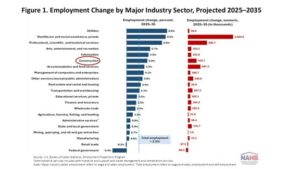
New analysis of Bureau of Labor Statistics employment projections from the National Association of Home Builders (NAHB) shows that the construction industry is expected to add 410,700 jobs between 2025 and 2035, representing a 5% increase compared to projected 3.5% growth for the entire U.S. workforce. As the chart illustrates, construction employment is projected to increase from approximately 8.27 million jobs in 2025 to 8.68 million in 2035. Specialty trade contractors are expected to account for the largest share of growth, adding 270,600 jobs, while residential building construction is projected to add 34,200 jobs. The findings highlight the growing demand for construction workers and the importance of workforce development in supporting expanded housing production over the next decade.
What we’re reading
An opinion piece by Rep. Max Miller (R-Ohio) in The Hill highlights how housing shortages in rural Ohio are limiting workforce recruitment and economic development. In Holmes County, a local housing study identified a need for approximately 858 additional owner-occupied homes and 280 rental units, while employers report difficulty attracting workers because of limited housing availability. Miller points to the recently enacted 21st Century ROAD to Housing Act as an opportunity to address housing issues. He emphasizes the importance of implementing the legislation in ways that reach smaller communities, alongside state initiatives and public-private partnerships that support development.
Reporting from PoliticoPro highlights announced plans from the Federal Emergency Management Agency (FEMA) to overhaul its flood maps to provide more accurate, detailed information about flood risks nationwide. The maps have faced criticism for relying on outdated data and primarily identifying whether properties fall within areas with a 1% annual chance of flooding, leaving many homeowners unaware of risks outside designated flood zones. FEMA’s proposed changes aim to provide a more comprehensive assessment of flood hazards, improve public understanding of flood exposure, and support decisions about development, mitigation, and insurance coverage.
A New York Times article examines how elevated mortgage rates and slowing residential construction are creating renewed pressure on the rental market, reversing several years of moderating rent growth. According to Zillow, national rents increased 2.7% year-over-year in September, compared to 2% a year earlier. High homeownership costs are keeping prospective buyers in rental housing longer, while elevated financing costs and construction challenges have slowed the development of new apartments. Economists warn that tightening rental supply could accelerate rent costs and complicate efforts to reduce inflation.
A new Preservation Brief from the National Housing Trust revisits that pivotal era and distills lessons for policymakers and practitioners working to preserve affordable homes today. Today’s preservation challenges are broader and larger in scale, but the response to the 1990s crisis still offers a valuable roadmap. The brief charts the introduction of seminal affordable housing preservation policies as well as the necessary capital resources, like the Low-Income Housing Tax Credit program, that supported the rehabilitation of existing properties and implemented additional affordability restrictions. The brief distills four key lessons from that era and identifies five priorities for a shared preservation policy agenda at the federal, state, and local level to ensure that our existing and new supply can be preserved for generations to come.