

In this issue
October 11, 2026
Issue 95-38
Production & Supply
Insurance
Regulatory Reform
- House report calls for stronger public housing oversight
- Treasury prepares proposal for restricting institutional investor home purchases
- Senate unveils bipartisan permitting reform proposal
Chart of the week
Production & Supply
HUD publishes action plan to advance manufactured housing
The U.S. Department of Housing and Urban Development (HUD) unveiled its Next Generation Manufactured Housing Action Plan, outlining steps to modernize federal manufactured housing standards and expand opportunities for factory-built housing. The announcement follows passage of the 21st Century ROAD to Housing Act, which eliminated the requirement that a manufactured home be constructed on a permanent chassis, opening the door to greater flexibility in housing design and construction. HUD’s plan calls for updating energy efficiency standards, addressing foundation and installation requirements, and developing new construction pathways to encourage innovation while maintaining safety standards.
In a related effort, HUD selected the National Institute of Building Sciences (NIBS) and its partner MOD X for a 12-month initiative to develop a framework for expanding factory-built construction to multifamily developments with five or more units. The initiative will examine regulatory, financing, insurance, and construction barriers while developing performance-based standards that allow greater flexibility in building design and materials. NIBS will also provide technical support for potential HUD demonstration projects. The effort aims to create a clearer regulatory pathway for factory-built multifamily housing, which could reduce development costs, accelerate construction timelines, and expand affordable housing supply.
Insurance
Sens. Warren, Hawley question insurers over rising share of unpaid claims
Sens. Elizabeth Warren (D-Mass.) and Josh Hawley (R-Mo.) sent letters to six major insurance companies raising concerns about the growing share of homeowners and auto insurance claims which are closed without payment to policyholders. The letters, sent to State Farm, Allstate, USAA, Farmers, Liberty Mutual, and American Family, follow reporting that the five largest home insurers closed more than 44% of resolved claims without payment in 2025, up from 36% a decade earlier. Similarly, auto insurers closed 45% of liability and medical claims without payment in 2025, compared to 35% a decade earlier. The senators questioned whether insurers are fulfilling their obligations to policyholders.
The inquiry comes as insurance costs continue to rise nationwide, adding to housing affordability pressures. The senators cited data showing that homeowners insurance premiums increased 70% nationally between 2019 and 2025, and that premiums for an average homeowner with $350,000 in rebuilding coverage increased approximately $760, or 39%, in 2025. They also referenced a 2024 Insurance Information Institute study finding that 12% of Americans lacked homeowners insurance, up from 5% in 2019. Sens. Warren and Hawley expressed concern that rising premiums and uncertainty regarding claims payments could lead more homeowners to forgo coverage, increasing their financial vulnerability to disasters and other property losses. The senators requested a response by Oct. 16.

Don’t miss THE event for housers – register today!
Join the National Housing Conference on December 8 at the National Press Club in Washington, D.C., for our annual Solutions for Affordable Housing convening. This premier event brings together policymakers, lenders, developers, advocates, researchers, housing providers, and other stakeholders to identify tangible, impactful, and achievable solutions that can move housing policy and practice forward.
This year’s sessions will tackle some of the most pressing issues facing affordable housing, including:
- Economic, political, and market forces shaping the year ahead.
- Challenges, opportunities, and solutions to expand access to housing.
- The impact of evolving mortgage finance policies and regulations on the housing market.
- What’s working to accelerate development and increase supply.
- Innovative approaches to expanding housing opportunities at the state level.
- Strategies to address labor shortages and strengthen the workforce.
- Emerging fair housing issues and challenges shaping the future of housing.
Members receive special discounted pricing!
In Person Tickets – $300
Virtual Tickets – $200
*NHC members receive exclusive discounts to Solutions for Affordable Housing.
Please reach out to info@nhc.org for more information.
Sponsorship Opportunities Available
Elevate your organization’s profile and actively participate in the conversations that are shaping the future of housing by sponsoring NHC’s Solutions for Affordable Housing convening. We offer sponsorship levels tailored to fit every organization’s needs, starting at $1,000. Learn more about sponsorship opportunities here.

Regulatory Reform
House report calls for stronger public housing oversight
House Financial Services Committee Chairman French Hill (R-Ark.) and Oversight and Investigations Subcommittee Chairman Dan Meuser (R-Pa.) released a staff report outlining 21 recommendations to strengthen oversight and accountability of public housing agencies (PHAs). The report follows an investigation of 32 PHAs that HUD has designated as troubled. The investigation identified inadequate property maintenance, financial mismanagement, staffing shortages, and inconsistent federal oversight as recurring challenges. Recommendations include establishing minimum qualifications for PHA leadership, improving maintenance and financial records, modernizing data systems, and strengthening HUD’s inspection processes.
Public housing groups have acknowledged the challenges but argued that adequate funding is needed to ensure successful operations and maintenance. “Time and time again, [PHAs] demonstrate that they are effective stewards of federal housing resources, doing more with less to serve their communities. Although PHAs are succeeding despite chronic underinvestment, PHAs could see even more success with full funding coupled with appropriate oversight,” testified Eric Oberdorfer, Director, Policy and Legislative Affairs at the National Association of Housing and Redevelopment Officials earlier this year.
Chairman Hill emphasized the potential for bipartisan cooperation on reforms, particularly as HUD faces significant rulemaking responsibilities under the recently enacted 21st Century ROAD to Housing Act. He also acknowledged concerns about HUD’s capacity to implement the legislation following substantial staffing reductions, noting that the changes will require considerable work to implement effectively.
Treasury prepares proposal for restricting institutional investor home purchases
The Treasury Department has submitted for review by the Office of Management and Budget (OMB) proposed regulations implementing the 21st Century ROAD to Housing Act’s restrictions on the purchase of single-family homes by large institutional investors. The proposal, titled Implementing the 21st Century Road to Housing Act’s Ban on Large Institutional Investor Purchases of Single-Family Homes; Part 1, was submitted to the Office of Information and Regulatory Affairs on Oct. 2. The law, enacted in July, restricts purchases of existing single-family homes by institutional investors that own more than 350 properties while providing exemptions for build-to-rent developments. The restrictions are intended to limit competition between large investors and prospective owner-occupant homebuyers without discouraging new rental housing construction. Treasury is expected to publish the proposed rules for public comment following completion of OMB’s review.
The regulatory review comes as institutional investors are increasing their share of home purchases. Investors owning more than 1,000 homes accounted for 2.2% of home sales in August, up from 1.4% in February. However, researchers noted that the increase may reflect a slowdown in purchases by individual homebuyers rather than a significant increase in institutional acquisitions. Industry representatives also reported renewed investment activity following passage of the housing legislation, which provided greater regulatory certainty, particularly for build-to-rent developers.
Senate unveils bipartisan permitting reform proposal
A bipartisan group of senators introduced the Bipartisan American Affordability and Jobs Act, a sweeping proposal to streamline federal environmental reviews and permitting requirements for major energy and infrastructure projects. The legislation was introduced by Sens. Shelley Moore Capito (R-W.Va.), Mike Lee (R-Utah), Sheldon Whitehouse (D-R.I.), and Martin Heinrich (D-N.M.). The proposal would establish two-year deadlines for environmental impact statements and one-year deadlines for less extensive environmental assessments under the National Environmental Policy Act (NEPA). It would also expand exemptions from environmental reviews, establish a 150-day window for certain legal challenges, and streamline permitting under the Clean Water Act. The legislation seeks to reduce development delays while providing greater certainty for infrastructure investments.
The proposal also addresses added demand and rising electricity costs from data centers by preventing infrastructure expenses associated with those facilities from being passed on to other utility customers. Additional provisions would expand federal authority over interstate electricity transmission projects, establish protections against the reversal of previously approved federal permits, and streamline reviews under the Endangered Species Act and National Historic Preservation Act.
The National Association of Home Builders (NAHB) expressed support for the proposal. “These provisions provide the industry with needed clarity and consistency during the federal permitting process,” said NAHB Chairman Bill Owens. Environmental organizations have raised concerns that the legislation could weaken environmental protections and limit challenges to permit requests, particularly through provisions related to the Endangered Species Act.

On October 22, leaders from across housing, healthcare, government, philanthropy, and the nonprofit sector will come together at the National Press Club in Washington, D.C., for “From Insight to Impact: Advancing Solutions in Veterans Housing.” Hosted by The Home Depot Foundation and the National Housing Conference, the convening will focus on identifying practical, actionable solutions to strengthen housing stability for veterans.
Throughout the day, speakers and attendees will explore some of the most pressing challenges forcing veterans and the organizations that serve them, including:
-
-
- Innovative partnerships connecting housing and healthcare.
- Data-driven strategies and proven approaches from communities across the country.
- New approaches to financing veteran housing.
- Solutions to meet the growing housing and care needs of aging veterans.
- Practical ideas that organizations can put into action in their own communities.
-
Thanks to the generous support of The Home Depot Foundation, guests may attend at no cost.
Seating is very limited, so reserve your spot today!

Chart of the Week: Flood exposure spans millions of uninsured properties
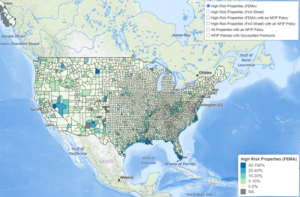
A new interactive map from the Government Accountability Office (GAO) finds that 86% of properties facing high flood risk lacked coverage through the National Flood Insurance Program (NFIP). GAO found that NFIP policies declined from 5.5 million in 2010 to 4.5 million in 2026, although growth in private flood insurance has helped offset the decline. Approximately 13 million high-risk properties are located outside federally designated Special Flood Hazard Areas, where flood insurance is generally required for federally backed mortgages. The report notes that existing federal flood maps do not adequately account for risks associated with heavy rainfall, leaving many homeowners unaware of their exposure.
What we’re reading
A new GAO report found that the U.S. Interagency Council on Homelessness (USICH), which coordinates federal efforts to address homelessness, continued to face operational challenges following staffing reductions. In April 2025, 11 of the agency’s 13 employees were placed on paid administrative leave, but eight returned in February 2026 following a federal court ruling that found the agency’s implementation of the executive order unlawful. Despite their return, staff reported receiving no direction from agency leadership on homelessness policies or priorities needed to fulfill statutory responsibilities.
A new analysis from the Federal Reserve Bank of New York found that homeowners remained exposed to significant financial risks despite carrying property insurance. Using data from millions of insurance contracts, researchers estimated that deductibles and coverage limits left households responsible for 29% of expected property losses. The analysis found that homeowners with lower credit scores and properties facing greater disaster risks retained more uninsured exposure, potentially leaving financially vulnerable households responsible for the greatest losses.
The Federal Reserve Bank of St. Louis published a new report exploring why manufactured homes face high mortgage denial rates. Analyzing data from 2018 to 2024, researchers found that manufactured home mortgage applications had denial rates more than 50 percentage points higher than site-built homes, with a gap of 5 to 8 percentage points remaining after accounting for income differences. The report identified appraisal challenges, property classifications, and limited access to secondary mortgage markets as key financing barriers. Researchers suggested that improving appraisal standards, expanding secondary market access, and simplifying property classifications could help expand affordable homeownership opportunities.