

In this issue
September 20, 2026
Issue 95-35
Community Development
Regulatory Reform
Production/Supply
Homelessness
Chart of the week
Community Development
Treasury releases delayed CDFI Fund awards
The U.S. Department of the Treasury’s Community Development Financial Institutions Fund (CDFI Fund) announced fiscal year 2025 and 2026 awards for four programs supporting lending and investment in low-income and underserved communities. The funding includes remaining FY 2025 awards for the Community Development Financial Institutions and Native American CDFI Assistance programs, as well as FY 2026 awards for the Bank Enterprise Award and Small Dollar Loan Programs. The funding will support affordable financial services, small-business and consumer lending, and community development investments nationwide. The announcement follows months of delays and occurred approximately two weeks before the authority to spend the fund expires. Several groups filed a lawsuit against Treasury last month seeking to prevent the funds from lapsing.
Credit union organizations responded to the announcement by highlighting the role CDFIs play in providing financial services in underserved communities. America’s Credit Unions noted that credit unions account for 365 of the nation’s 1,276 certified CDFIs and said the awards will provide home loans, small-business financing, and consumer credit in low-income, rural, and underserved areas. The Defense Credit Union Council similarly said the funding will expand affordable lending, including for service members, veterans, and military families, while calling for clear award terms and practical compliance requirements going forward. Treasury said recipients will receive official award notifications by Sept. 30 and awards will be subject to federal audits, compliance reviews, and other oversight requirements.
“Today’s awards reflect Treasury’s commitment to ensuring responsible stewardship of taxpayer dollars and advancing economic opportunity in communities that need it most,” said Treasury Secretary Scott Bessent. “Treasury will maintain oversight of these awards to ensure they spur investment in low-income and distressed communities, support local economic growth, expand opportunity, and deliver lasting results for the American people.”
Regulatory Reform
Matt Jones nominated as FHA commissioner
President Donald Trump has nominated Matt Jones to serve as Assistant Secretary for Housing and Federal Housing Commissioner at the U.S. Department of Housing and Urban Development (HUD). Jones currently serves as HUD’s deputy assistant secretary for single-family housing, where he oversees an FHA insurance portfolio of more than eight million loans with an unpaid principal balance exceeding $1.6 trillion. If confirmed by the Senate, Jones would oversee FHA’s single-family, multifamily, and healthcare mortgage insurance programs, including policies related to underwriting, appraisals, loan servicing, lender oversight, and mortgage insurance.
The nomination comes as FHA implements several changes affecting mortgage lending and servicing. HUD has recently revised appraisal requirements and loss-mitigation policies and plans to make VantageScore 4.0 and FICO 10T available for FHA lending beginning in January 2027.
NHC congratulated Jones in a statement, noting that he “brings a wealth of housing experience and a deep commitment to affordable homeownership. His background in the mortgage industry and knowledge of housing policy has prepared him well for this role.”
FOMC raises rate by quarter point
The Federal Reserve’s Federal Open Market Committee (FOMC) voted unanimously to raise the target federal funds rate by 25 basis points to a range of 3.75%-4%. The move marks the first rate increase in three years and the first under Chair Kevin Warsh. The committee noted that economic activity continues to expand at a solid pace, supported by resilient consumer spending, strong productivity growth, and robust capital investment. However, inflation remains elevated and geopolitical challenges have complicated the economic outlook, prompting the Fed to tighten monetary policy in support of its 2% inflation goal.
The decision came amid continued calls from President Trump for the Fed to lower rates. A majority of FOMC members anticipate a second rate increase before the end of the year. Mortgage rates, which are not directly set by the Fed but are influenced by broader economic conditions, continued to rise following the Fed’s decision.
“The committee’s unanimous vote shows our resolve to achieve price stability on a timelier basis. We aim to ensure that credit and financial conditions are consistent over time with our mandate, that relative price changes in some sectors of the economy do not broaden, that inflation compensation in market prices stays low, and that inflation expectations remain well-anchored,” stated Chair Kevin Warsh during a press conference.

Meet the leaders joining NHC for Solutions for Affordable Housing
Join the National Housing Conference on December 8 at the National Press Club in Washington, D.C., for our annual Solutions for Affordable Housing convening. This premier event brings together policymakers, lenders, developers, advocates, researchers, housing providers, and other stakeholders to identify tangible, impactful, and achievable solutions that can move housing policy and practice forward.
This year’s sessions will examine the economic, political, and market forces shaping housing in 2027, including affordability, housing supply, mortgage finance, and the evolving policy and regulatory landscape. Experts will also explore what’s working to overcome barriers to new housing production, innovative state approaches to expanding supply and affordability, strategies to strengthen the construction workforce, and emerging fair housing issues. Leaders joining these discussions include:
-
-
- Keith Bickel, SVP, Public Policy, Bank of America
- Marisa Calderon, President & CEO, Prosperity Now
- Michael Calhoun, President, Center for Responsible Lending
- Pete Carroll, EVP, Public Policy & Industry Relations, Cotality
- David Dworkin, President & CEO, National Housing Conference
- Sharon Wilson Géno, President, National Multifamily Housing Council
- Laurie Goodman, Institute Fellow & Founder of the Housing Finance Policy Center, Urban Institute
- Selma Hepp, Chief Economist, Cotality
- Michael Pugh, President & CEO, Local Initiatives Support Corporation (LISC)
- Gisele Roget, Principal, Overbrook Square Group
- Nate Shultz, Senior Vice President of Policy, National Housing Conference
- Jim Tobin, President & CEO, National Association of Home Builders
- Sam Valverde, Managing Director, Falcon Capital Advisors
-
Take advantage of special early bird member pricing through October 9!
In Person Tickets – $350
Virtual Tickets – $200
*NHC members receive exclusive discounts to Solutions for Affordable Housing. Please reach out to info@nhc.org for more information.
Sponsorship Opportunities Available
Elevate your organization’s profile and actively participate in the conversations that are shaping the future of housing by sponsoring NHC’s Solutions for Affordable Housing convening. We offer sponsorship levels tailored to fit every organization’s needs, starting at $1,000. Learn more about sponsorship opportunities here.
Production/Supply
House bill would declare national housing emergency
Rep. Chrissy Houlahan (D-Pa.) introduced the House version of the National Housing Emergency Act, legislation that seeks to build or rehabilitate four million homes. Sen. Elissa Slotkin (D-Mich.) introduced the Senate version in January. The bill would require the president to declare a national housing emergency and invoke the Defense Production Act to increase domestic production of construction materials including lumber, steel, and manufactured housing. The emergency would remain in effect until four million additional homes are built or rehabilitated, or until Oct. 1, 2031, whichever comes first.
The legislation would also tie certain federal funding eligibility to housing growth and push states and localities to adopt policies that facilitate development. During the emergency, states and local governments would also be prohibited from imposing land-use regulations that substantially burden housing construction or rehabilitation.
“We need to start treating the high cost of housing like the crisis it is,” Rep. Houlahan said, arguing that the measure is designed to relieve supply constraints and lower costs for renters and homebuyers.
The National Housing Emergency Act is endorsed by the National Housing Conference, National Leased Housing Association and National Housing & Rehabilitation Association.

On October 22, leaders from across housing, healthcare, government, philanthropy, and the nonprofit sector will come together at the National Press Club in Washington, D.C., for “From Insight to Impact: Advancing Solutions in Veterans Housing.” Hosted by The Home Depot Foundation and the National Housing Conference, the convening will focus on identifying practical, actionable solutions to strengthen housing stability for veterans.
Throughout the day, speakers and attendees will explore some of the most pressing challenges forcing veterans and the organizations that serve them, including:
-
-
- Innovative partnerships connecting housing and healthcare.
- Data-driven strategies and proven approaches from communities across the country.
- New approaches to financing veteran housing.
- Solutions to meet the growing housing and care needs of aging veterans.
- Practical ideas that organizations can put into action in their own communities.
-
Thanks to the generous support of The Home Depot Foundation, guests may attend at no cost.
Seating is very limited, so reserve your spot today!
Homelessness
VA awards record homelessness funding
The Department of Veterans Affairs (VA) announced a record $1.17 billion in grants to 680 organizations nationwide to help veterans experiencing or at risk of homelessness. The funding will be distributed in fiscal year 2027 and follows VA’s placement of 51,936 veterans into permanent housing in fiscal year 2025, the highest number in seven years.
“VA is making historic progress getting our most vulnerable Veterans off the streets and back on the path to self-sufficiency,” said VA Secretary Doug Collins. “These grants underscore our commitment to expanding critical services that prevent Veteran homelessness, connecting those who have worn the uniform to permanent housing and providing the resources necessary for long‑term stability.”
Of the total funding, $855 million will support one-year grants through VA’s Supportive Services for Veteran Families program beginning Oct. 1. The grants will fund services aimed at preventing housing loss, helping veterans and their families find more suitable housing, and rapidly rehousing those experiencing homelessness. The additional $318 million will support three-year grants through the Grant and Per Diem program for transitional housing, service centers, transition-in-place housing, and specialized housing for veterans with additional needs, including women veterans, older veterans, and veterans caring for minor dependents.

Chart of the Week: Existing home supply continues to grow
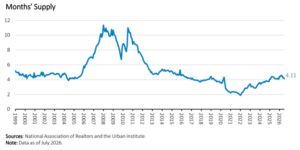
The Urban Institute’s August 2026 Chartbook shows that existing-home inventory continues to recover, reaching 4.11 months of supply in July. That is more than double the roughly two months of supply recorded in early 2022, when limited inventory intensified competition and helped drive rapid home price growth. Still, today’s inventory remains below the five-to-six-month supply generally associated with a balanced housing market and far below the 10-month-plus levels seen during the foreclosure crisis. Higher mortgage rates have slowed sales and given buyers more options, but the data suggest that supply constraints remain a defining feature of the housing market.
What we’re reading
Politico reported that Federal Housing Finance Agency Director Bill Pulte directed Fannie Mae to permit mortgage servicers to proactively notify borrowers when they may qualify to cancel private mortgage insurance. Borrowers with Fannie Mae-backed mortgages typically must carry mortgage insurance when they make a down payment of less than 20% but may be able to remove the coverage after building sufficient equity through loan repayment or growth in home value. The policy would align Fannie Mae with Freddie Mac, which already permits proactive outreach to borrowers approaching mortgage-insurance termination thresholds, and could help eligible homeowners avoid paying for coverage they no longer need.
The Government Accountability Office (GAO) released a new report outlining preliminary observations on federal housing assistance for American Indian, Alaska Native, and Native Hawaiian communities. GAO identified 30 federal programs that can provide targeted housing support, but tribal organizations continue to face significant housing and homelessness challenges. GAO noted that limited funding is often directed toward operating and maintaining existing housing rather than developing new units or expanding homelessness services. Tribal representatives also described difficulties using federal homelessness programs and data systems that may not fully account for households that are doubled up or otherwise experiencing unstable housing outside of traditional shelter settings.
The Atlantic examined the growing political push to reduce or eliminate property taxes, focusing on a proposed Florida constitutional amendment that would substantially expand the state’s homestead exemption. The article argues that while property-tax relief can help current homeowners manage rising assessments, broad reductions in local revenue can create tradeoffs for public services and may shift costs to renters and future homebuyers through higher sales taxes, fees, rents, or home prices. It also points to California’s Proposition 13 as an example of how limits on property taxes can reshape local finance and housing markets over time.
The September FHA+ issue examines a decade of data on homeowners insurance, with Michael J. Marshall and Gerald Flood finding premiums rose 78 percent — driven by rebuilding costs, not storms. Dror Oppenheimer breaks down FHA’s proposed RAP demonstration, an alternative to the traditional partial claim. Inside Voices tracks HUD’s $450 million note sale, the ROAD Act’s small-dollar pilot, and a $15.5 million insurance settlement. The Gate House Index shows partial claim balances nearly tripling since 2020.