

In this Issue
September 13, 2026
Issue 95-34
Regulatory Reform
- Treasury publishes OZ rule proposal for data collection
- Pulte directs Enterprises to use VantageScore
Racial Equity
Community Development
Homelessness
Homeownership
Chart of the week: High-risk markets show uneven home price trends
Regulatory Reform
Treasury publishes OZ rule proposal for data collection
The U.S. Treasury Department and the Internal Revenue Service (IRS) released proposed regulations implementing new reporting requirements for the Opportunity Zone (OZ) program, providing greater detail on how investments and their community impacts will be tracked. The requirements were enacted as part of the 2025 tax law that extended the OZ program and authorized a new round of designations, including additional incentives for rural communities. The proposal would require Qualified Opportunity Funds and Opportunity Zone businesses to report information on investments, business activity, and employment within individual census tracts.
The new data would also provide more information about the program’s impact on housing. Treasury would collect the number of residential units produced through OZ investments, while future public reports would include information on rents, homeownership rates, residential property values, and the number of affordable housing units within designated census tracts. Certificates of occupancy would generally be used to measure completed residential units.
Comments on the proposal are due 45 days after publication in the Federal Register and a public hearing is scheduled for Nov. 5.
Pulte directs Enterprises to use VantageScore
Federal Housing Finance Agency (FHFA) Director Bill Pulte announced via social media that “ALL Mortgage Backed Securities (MBS), ALL Credit Risk Transfers (CRT), and ANY Securitized Product issued by Fannie Mae and Freddie Mac will now carry a VantageScore, in addition to a FICO score.” A week prior, Pulte had announced the immediate approval of all lenders to use VantageScore 4.0 for mortgages backed by the agencies, after a more limited rollout earlier this year. He also hinted that further changes to traditional credit reporting systems may be forthcoming.
“Equifax, Experian, and TransUnion have been overcharging Americans for far too long. This will end soon. We are seriously considering bi-merge, and stronger solutions (SAFER and SOUNDER). We will not allow companies to take advantage of American consumers,” Pulte wrote in his posts, referring to an anticipated shift away from requiring reporting from three credit bureaus to only two. Moving from tri-merge to bi-merge reporting has long been discussed by FHFA, though some credit agencies and research groups urge caution regarding implementation of a bi-merge model.
Groups including the Mortgage Bankers Association lauded the latest announcement, welcoming “full adoption of VantageScore 4.0 as an important step toward modernizing the credit scoring framework, increasing competition, and lowering costs for borrowers.” The Community Home Lenders of America also supported the action, stating it will increase competition and save borrowers money.
“The FHFA is leading the charge in bringing the mortgage industry into a modern era,” said Anthony Hutchinson, EVP and Head of Public Affairs at VantageScore, in a statement. “The disclosure of VantageScore 4.0 scores to Fannie Mae and Freddie Mac investors will rapidly accelerate VantageScore adoption in the capital markets and mortgage markets alike, giving market participants access to the most modern and innovative credit model.”
Racial Equity
NFHA wins case against HUD
A federal judge has blocked the U.S. Department of Housing and Urban Development’s (HUD) plan to change the way in which it funds fair housing enforcement. Judge Myong Joun of the U.S. District Court for the District of Massachusetts ruled that HUD’s justification for the revamped grant notices was “pretextual” and dismissed the justification as implausible, stating that it “belies credulity” under the notion that the redesign would strengthen the Fair Housing Initiatives Program (FHIP). The National Fair Housing Alliance (NFHA) and the Massachusetts Fair Housing Center, whose July lawsuit prompted the ruling, argued that the redesigned notices would effectively disqualify the nonprofit enforcement groups the program has supported since 1987. In accordance with the temporary restraining order, HUD must operate its fiscal year 2025 grant competition under the same framework used the previous year.
At issue was a funding notice that replaced FHIP’s traditional grant categories, which pay for discrimination testing, complaint investigation, and public education about housing rights, limiting eligibility to applicants with a budget of at least $5 million in annual spending. This change would have made more than 100 groups ineligible for federal support. The plaintiffs warned that some groups would have shut down entirely, while others would have been forced to lay off staff and scale back services.
The ruling comes as HUD continues to alter its fair housing policies. NFHA and a coalition of 79 organizations condemned the department’s move to an English-only discrimination complaint form, and later its rollback of rights for disabled residents, a change HUD positioned as a way to make housing more affordable. The litigation is expected to continue.
“Activist opposition will not deter the Department,” said HUD Deputy Secretary Andrew Hughes when the lawsuit was initially filed. “Under President Trump and Secretary Turner’s leadership, the free lunch for activists has ended.”
HUD has already issued fiscal year 2026 notices that, according to the plaintiffs, would again lock out established enforcement groups. The department said it “stands behind the lawfulness of its NOFOs” and will “continue these efforts, including availing itself of all legal options.”

Early Bird Registration Now Open
Join the National Housing Conference on December 8 at the National Press Club in Washington, D.C., for our annual Solutions for Affordable Housing convening. This premier event brings together leaders from across the affordable housing ecosystem, including government, philanthropy, nonprofit organizations, real estate development, lending, and other sectors, to build connections and advance housing priorities that are tangible, impactful, and achievable.
Through engaging discussions with national experts and policymakers, attendees will gain a deeper understanding of the most pressing housing challenges facing communities today and the federal, state, and local policies shaping solutions.
Whether you’re looking to strengthen partnerships, stay ahead of emerging trends, or better align your organization’s work with the nation’s housing priorities, Solutions for Affordable Housing offers valuable insights and actionable ideas to help drive meaningful progress.
In Person Tickets – $350
Virtual Tickets – $200
*NHC members receive exclusive discounts to Solutions for Affordable Housing. Please reach out to info@nhc.org for more information.
Sponsorship Opportunities Available
Elevate your organization’s profile and actively participate in the conversations that are shaping the future of housing by sponsoring NHC’s Solutions for Affordable Housing convening. We offer sponsorship levels tailored to fit every organization’s needs, starting at $1,000. Learn more about sponsorship opportunities here.
Community Development
CDFI Fund appoints new director
The U.S. Department of the Treasury named Chris Miller as Director of the Community Development Financial Institutions (CDFI) Fund. Miller joins the Fund from Three Roots Capital, a certified CDFI based in Knoxville, Tenn., where he worked on financial and administrative management, access to capital programs, and operational assistance for businesses. He brings 20 years of experience providing and expanding access to capital for small businesses.
“I am honored to serve as a presidential appointee and Director of the CDFI Fund, bringing my industry experience in community development finance to this important role,” said Miller. “I look forward to working with the CDFI Fund’s talented team, the industry, and our stakeholders to advance the Administration’s economic agenda, expand access to capital, and create opportunity in communities across America.”
The change comes amid continued uncertainty surrounding the CDFI Fund. Over the last year, the program has faced threats of dissolution and cuts on multiple occasions, and fiscal year 2026 awards still have not been released. In an open letter to Director Miller, America’s Credit Unions outlined multiple steps the new director can take to achieve predictable capital disbursement for CDFI Fund awardees. The repeated threats to shut down the CDFI Fund and reduce its capacity have also led to legal action from the Cameo Network and Inclusive Action for the City, which argue that “The challenged delays in apportioning and awarding the funds, if left unchecked, will cause direct, immediate, significant, and irreparable harm to CDFIs and the communities they serve.”

Homelessness
VA announces emergency assistance program
The Department of Veterans Affairs (VA) announced a new $29 million initiative to provide emergency supplies and transportation assistance to eligible veterans experiencing homelessness and veterans participating in the HUD-Veterans Affairs Supportive Housing (HUD-VASH) program. The program will allow VA to provide necessities including food, shelter, clothing, hygiene items, and technology that can help veterans stay connected with service providers, prospective landlords, and family members.
Beginning in early fiscal year 2027, VA medical centers will be able to distribute up to $11 million in goods and services based on recommendations from VA clinicians. VA also plans to provide up to $18 million in transportation services to help homeless veterans attend medical and counseling appointments, search for housing and employment, and access food and other necessities.
Homeownership
Mortgage rates top 7%
Mortgage rates topped 7% this week, adding pressure to prospective homebuyers already facing elevated housing costs. Zillow reported the average 30-year purchase mortgage interest rate at just over 7%, citing the underlying bond market and the announcement of the U.S. Treasury buyback program. Freddie Mac reported that the average 30-year fixed-rate mortgage increased to 6.76% for the week ending Sept. 10, up from 6.71% the previous week and 6.35% one year earlier. The Mortgage Bankers Association (MBA) also reported that the average contract rate for a conforming 30-year fixed mortgage reached 6.85% during the week ending Sept. 4, the highest level since June 2025 and 36 basis points above the same period last year. MBA attributed the increases to investor concerns about inflation and the federal budget deficit.
“For shoppers who didn’t find a home during peak season, the math has gotten more challenging,” noted Kara Ng, Senior Economist for Zillow.
Rates are anticipated to remain above 6% for the foreseeable future.
Chart of the week: High-risk markets show uneven home price trends
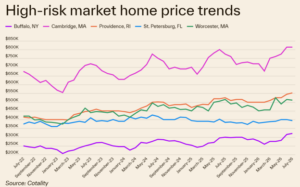
Cotality’s September 2026 Home Price Insights highlights home-price trends in five markets it identifies as being at high risk of price declines. Prices remain above 2022 levels in each market, but the data show increasingly uneven growth amid higher mortgage rates and other affordability pressures. Cambridge, Mass., saw the largest increase since July 2022, with home prices rising from $676,000 to $815,000. Providence, R.I., increased from $415,000 to $552,500 during that time period, while Worcester, Mass., rose from $420,000 to $512,000. Buffalo, N.Y., and St. Petersburg, Fla., have experienced more limited appreciation and noticeable volatility. Buffalo fell from a late-2025 high near $285,000 before rebounding to about $305,000 in July 2026, while St. Petersburg remained near $380,000 after declining from its mid-2024 peak. The data illustrate how home prices can remain elevated over several years, even as short-term momentum weakens and vulnerability to future price declines increases.
What we’re reading
PoliticoPro reported on a HUD notice that was briefly published for inspection in the Federal Register that outlined plans to reorganize the agency. The proposed restructuring would consolidate functions across several offices, including Public and Indian Housing and Community Planning and Development, while creating new functions within Ginnie Mae and HUD’s information technology operations. HUD said the reorganization was intended to help the department operate more effectively after significant voluntary staff departures and was not expected to produce immediate cost savings. The Federal Register now lists the reorganization document as withdrawn, leaving the timing and status of the proposed changes unclear.
Analysis from the National Association of REALTORS® finds that the effects of data centers on housing markets vary considerably. The report identified 1,474 data centers across 251 U.S. counties and found that counties with high concentrations generally have higher home values and stronger long-term job growth. However, it cautions that these correlations do not establish that data centers cause those outcomes. REALTOR® survey responses were also mixed: 25% reported a positive effect on nearby residential values, while 22% reported a negative effect. Clients’ most common concerns centered on energy costs, water use, and environmental impacts.
The Associated Press reported that extremely low-income renters face a severe housing shortage even as some income-restricted apartments sit vacant. The National Low Income Housing Coalition estimates that there are about 4 million affordable rental homes for 11 million extremely low-income renter households, while only 12% of affordable units financed through the Low-Income Housing Tax Credit in 2024 were designated for this income group. In places such as Austin, Texas; Denver, Colo.; and Portland, Ore., units targeting households earning 60% to 80% of area median income can be priced close to market-rate apartments, resulting in vacancies even as households with the lowest incomes remain unable to afford housing.